Author: admin

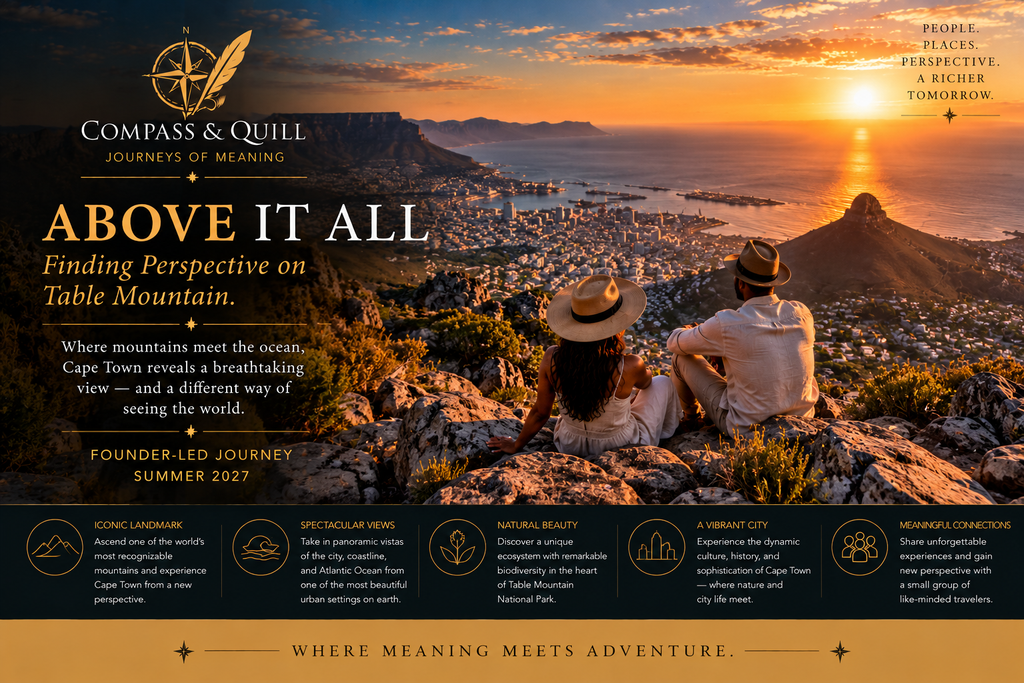
  • Above It All: Finding Perspective on Cape Town’s Table Mountain

    Above It All: Finding Perspective on Cape Town’s Table Mountain

    “Sometimes, the only thing standing between us and a different perspective is the willingness to rise above what surrounds us.”

    There are cities that impress you with their architecture.

    Others captivate you with their history.

    Some are remembered for their food, their culture, or the energy of their streets.

    And then there is Cape Town.

    A city where mountains rise dramatically above the Atlantic coastline, where the natural world remains an unmistakable part of the urban landscape, and where one of Africa’s most recognizable landmarks watches over everything below.

    Table Mountain.

    During our 2027 Compass & Quill Founder-Led Journey through Southern Africa, Cape Town represents the final chapter of an extraordinary adventure.

    And few places offer a more remarkable perspective on this city than the summit of its iconic mountain.


    A Mountain That Defines a City

    Table Mountain is not simply a landmark.

    It is part of Cape Town’s identity.

    Its broad, remarkably level summit rises more than 1,000 meters above sea level, forming a dramatic backdrop to the city below.

    From almost anywhere in central Cape Town, the mountain commands attention.

    Its cliffs rise above neighborhoods and historic buildings.

    Its slopes frame the city.

    And depending on the weather, a delicate blanket of cloud may spill over its summit, creating the famous tablecloth effect.

    The mountain changes character throughout the day.

    At sunrise, it catches the first light.

    By afternoon, its cliffs stand in sharp contrast against the sky.

    And as evening approaches, the surrounding landscape takes on a softer, golden glow.

    But perhaps the most extraordinary way to appreciate Table Mountain is not from below.

    It is from above.


    The Journey to the Summit

    For many visitors, the experience begins aboard the Table Mountain Aerial Cableway.

    As the cable car rises, Cape Town gradually unfolds beneath you.

    The city becomes a remarkable arrangement of streets, buildings, coastline, and green spaces.

    The Atlantic Ocean stretches toward the horizon.

    Lion’s Head rises nearby.

    And the distinctive geography that makes Cape Town so extraordinary becomes increasingly clear.

    The journey itself is part of the experience.

    With each passing moment, the view expands.

    What seemed enormous at street level begins to take on a different scale.

    And by the time you reach the summit, the city you thought you understood has become something entirely new.

    Cableway operations are weather-dependent, and summit access would be subject to conditions and final itinerary arrangements.


    When the World Opens Up

    There is something extraordinary about standing high above a city.

    From the summit of Table Mountain, the landscape stretches in multiple directions.

    The Atlantic coastline curves around the Cape Peninsula.

    The city extends toward the surrounding mountains.

    Robben Island can be visible offshore when conditions are clear.

    And beyond the urban landscape lies an extraordinary meeting of land, sea, and sky.

    For a moment, the individual details of the city give way to a much larger picture.

    You no longer see only buildings.

    You see geography.

    You see how neighborhoods connect.

    You see how the coastline shapes the city.

    You begin to understand why Cape Town developed where it did.

    Elevation changes more than the view.

    It changes what becomes visible.


    A Lesson in Perspective

    Founders and executives spend much of their time close to the details.

    Budgets.

    Operations.

    Decisions.

    Deadlines.

    People.

    Problems.

    Opportunities.

    Each demands attention.

    And often, that attention is necessary.

    But there is a danger in remaining too close to everything for too long.

    We begin to see only what is immediately in front of us.

    The urgent issue.

    The unfinished project.

    The next obstacle.

    The decision waiting to be made.

    Sometimes, what we need isn’t more information.

    It’s distance.

    A different vantage point can reveal relationships and possibilities that were invisible from where we stood before.

    That is one of the reasons travel can be so valuable.

    It temporarily removes us from familiar surroundings and invites us to see the world—and sometimes our own lives—from another perspective.

    Table Mountain offers a particularly beautiful expression of that idea.


    More Than a Beautiful View

    Table Mountain is also an extraordinary natural environment.

    The mountain forms part of Table Mountain National Park and the Cape Floristic Region, an area recognized internationally for its remarkable biodiversity.

    The surrounding landscape is home to distinctive fynbos vegetation, including numerous plant species found naturally only within this region.

    This is part of what makes the mountain so fascinating.

    From a distance, it appears almost architectural.

    A massive, flat-topped formation rising above the city.

    But up close, it is a living ecosystem.

    Plants grow among the rocks.

    Small animals move through the landscape.

    Birds navigate the cliffs and slopes.

    And the mountain’s natural character becomes just as compelling as its famous views.

    It is a reminder that even the most recognizable landmarks often contain layers of beauty we don’t notice from a distance.


    The Beauty of Not Rushing

    Imagine reaching the summit on a clear Cape Town morning.

    The air is cool.

    The ocean stretches toward the horizon.

    The city lies far below.

    There are photographs to take, certainly.

    But after the first few moments, something changes.

    Perhaps you find a quiet place to sit.

    Perhaps you walk along a designated path, stopping whenever another view catches your attention.

    Perhaps you simply stand and watch the clouds move across the surrounding peaks.

    There is no need to hurry.

    No need to immediately move on.

    The view isn’t going anywhere.

    And for travelers accustomed to lives organized around appointments and responsibilities, that freedom can feel extraordinary.

    Sometimes the greatest luxury is having enough time to appreciate exactly where you are.


    Cape Town: Where Nature and Sophistication Meet

    One of the reasons Cape Town belongs in our Founder-Led Journey is its remarkable combination of natural beauty and cosmopolitan sophistication.

    Few major cities offer such immediate access to mountains, beaches, vineyards, celebrated restaurants, art, design, and extraordinary hospitality.

    You can spend the morning surrounded by mountain scenery and the afternoon enjoying the sophistication of the city’s waterfront.

    You can explore the region’s cultural history, discover its culinary creativity, or simply appreciate the landscape from an exceptional hotel.

    That diversity is part of Cape Town’s appeal.

    It offers an entirely different experience from the wilderness regions we’ll have visited earlier in our journey.

    And after nearly three weeks of exploring Southern Africa, that contrast becomes especially meaningful.


    The Conversations That Follow

    By the time our travelers arrive in Cape Town, they will have shared an extraordinary collection of experiences.

    Victoria Falls.

    Botswana’s remarkable wildlife.

    The waterways of the Okavango Delta.

    Namibia’s ancient desert.

    Sunrise adventures.

    Unforgettable sunsets.

    Exceptional meals.

    And conversations that began between strangers but gradually became something more.

    Imagine standing together on Table Mountain, looking out over Cape Town.

    Someone recalls a favorite safari encounter.

    Another remembers the stillness of the Namib Desert.

    Someone else reflects on a conversation that changed the way they were thinking about something back home.

    There is something meaningful about reaching a place like this near the end of a journey.

    The view becomes more than a panorama.

    It becomes an opportunity to look back.


    The Difference Between Distance and Detachment

    There is an important distinction between stepping away from responsibility and abandoning it.

    Founders sometimes struggle with this.

    We become accustomed to being involved in everything.

    We carry the weight of decisions.

    We feel responsible for outcomes.

    And even when we travel, part of our attention remains attached to what is happening at home.

    But distance can be productive.

    Not because it eliminates responsibility.

    Because it allows us to return to responsibility with greater clarity.

    When we step outside our normal environment, we often begin asking different questions.

    What truly matters?

    Which priorities deserve more attention?

    What have I been overlooking?

    What am I building toward?

    Those questions are difficult to consider when every day is filled with immediate demands.

    Sometimes we need to rise above the noise to hear ourselves think.


    A City Worth Understanding

    Of course, Cape Town is more than its natural beauty.

    It is a city shaped by complex histories, diverse communities, cultural expression, and ongoing transformation.

    Its extraordinary landscapes exist alongside important conversations about identity, opportunity, inequality, and the future.

    Meaningful travel invites us to appreciate both.

    The beauty of a destination.

    And the stories of the people who call it home.

    That is part of the Compass & Quill philosophy.

    We want our travelers to experience extraordinary places without reducing them to scenery.

    Because the most memorable journeys don’t simply show us where we are.

    They help us understand something about the place itself.


    Why Table Mountain Belongs in Our Story

    Throughout our Founder-Led Journey, different destinations will offer different forms of perspective.

    Victoria Falls will remind us of nature’s power.

    Botswana will introduce us to the extraordinary rhythms of the wilderness.

    Namibia will challenge our understanding of time and scale.

    Johannesburg will offer insight into history, enterprise, and reinvention.

    And Cape Town will bring these experiences together in a setting of remarkable beauty and sophistication.

    Table Mountain becomes a fitting symbol of that final chapter.

    A place where we can look outward across an extraordinary landscape.

    And perhaps inward at everything the journey has meant.


    Looking Ahead to 2027

    Next June, our Founder-Led Journey will take us across some of Southern Africa’s most extraordinary landscapes.

    We’ll experience moments of exhilaration.

    Moments of discovery.

    Moments of stillness.

    And moments of meaningful connection.

    Then, as our journey reaches Cape Town, we’ll find ourselves beneath one of the world’s most recognizable mountains.

    Perhaps conditions will allow us to ascend to its summit.

    Perhaps we’ll stand above the city, looking toward the Atlantic as the landscape stretches endlessly before us.

    And perhaps, after everything we’ve experienced, the view will mean something different than it would have at the beginning.

    Because sometimes perspective isn’t simply about how high we climb.

    It’s about everything we’ve experienced along the way.

    And that may be one of the most valuable things we carry home.

    Where Meaning Meets Adventure.
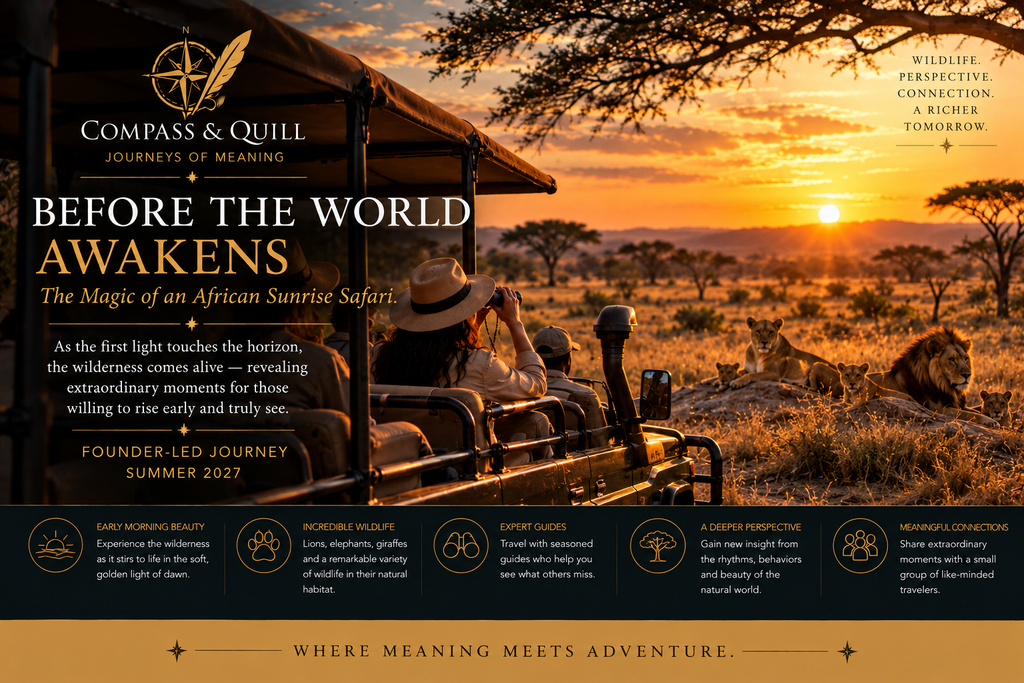
  • Before the World Awakens: The Magic of an African Sunrise Safari

    Before the World Awakens: The Magic of an African Sunrise Safari

    “Some of life’s most extraordinary moments begin before the rest of the world is awake.”

    The morning begins in darkness.

    Outside, the African wilderness is still wrapped in the cool silence of night.

    A warm cup of coffee awaits.

    Somewhere nearby, a safari vehicle is being prepared.

    There is a quiet anticipation in the air.

    No one knows exactly what the morning will bring.

    Perhaps lions returning from a night of hunting.

    A leopard resting among the branches of a tree.

    Elephants moving through the early morning mist.

    Or a herd of antelope silhouetted against the first light of dawn.

    Then the engine starts.

    And we venture into the wilderness.

    This is the magic of an African sunrise safari.

    And during our 2027 Compass & Quill Founder-Led Journey through Southern Africa, it represents another extraordinary opportunity to experience the natural world on its own terms.


    The Wilderness Before Sunrise

    There is something remarkable about Africa in the moments before dawn.

    The landscape feels different.

    The air is cooler.

    The light is softer.

    Sounds travel through the stillness.

    And the wilderness is already active, even before the sun appears.

    For many animals, the cooler hours of early morning are an important period of movement and activity.

    Predators may still be returning from their nighttime pursuits.

    Herbivores begin feeding.

    Birds announce the approaching daylight.

    And the landscape gradually reveals itself as darkness gives way to morning.

    The experience is entirely different from observing wildlife beneath the intensity of the midday sun.

    There is a sense of possibility in every direction.


    The Art of Seeing What Others Miss

    One of the greatest privileges of an exceptional safari is traveling with an experienced guide.

    Because there is a remarkable difference between looking at the wilderness and understanding what you’re seeing.

    A guide may notice a fresh footprint in the sand.

    A broken branch.

    A bird’s alarm call.

    A subtle movement in the grass.

    To an inexperienced observer, these details might mean very little.

    To someone who understands the landscape, they can reveal an entire story.

    Perhaps an animal passed through only moments earlier.

    Perhaps something is moving nearby.

    Perhaps a particular sound signals the presence of a predator.

    The wilderness is constantly communicating.

    But understanding its language requires knowledge, patience, and experience.

    And that is part of what makes a guided safari so extraordinary.

    You aren’t simply being shown animals.

    You’re being introduced to an entirely different way of seeing the world.


    The Moment Everything Changes

    Imagine the vehicle coming to a gentle stop.

    Your guide has noticed something.

    At first, you see nothing unusual.

    Just tall grass.

    A few trees.

    The soft glow of morning light.

    Then, slowly, a shape emerges.

    A lioness resting beneath a tree.

    Or perhaps a leopard moving almost invisibly through the vegetation.

    Everyone becomes quiet.

    Cameras are raised.

    But for a moment, the most important thing is simply watching.

    The animal moves according to its own instincts.

    It has no interest in our itinerary.

    No obligation to provide the perfect photograph.

    No awareness of how far we’ve traveled to be there.

    And that is precisely what makes the encounter so extraordinary.

    We are visitors in a world that does not revolve around us.


    Why the Early Hours Matter

    There is a reason sunrise game drives are such an important part of the safari experience.

    The cooler temperatures can encourage wildlife activity, while the softer morning light offers beautiful opportunities for observation and photography.

    But there is something else.

    The atmosphere.

    The anticipation.

    The gradual transformation of the landscape.

    As the sun rises, the wilderness changes almost minute by minute.

    The shadows retreat.

    Colors deepen.

    The golden light catches the grasses and trees.

    And animals that were nearly invisible moments earlier begin to emerge.

    Even without a dramatic wildlife encounter, the experience can be breathtaking.

    Because sometimes the landscape itself becomes the highlight.


    The Luxury of Expert Guidance

    Luxury travel is often associated with beautiful accommodations, exceptional dining, and seamless transportation.

    Those things matter.

    But on safari, another form of luxury becomes especially valuable.

    Access to exceptional knowledge.

    An experienced guide can transform an ordinary drive through the wilderness into an extraordinary learning experience.

    They understand the behavior of wildlife.

    They recognize the significance of small details.

    They know when to move and when to remain still.

    They understand the importance of respecting animals and maintaining appropriate distances.

    And perhaps most importantly, they know that the best encounters cannot be forced.

    True expertise doesn’t attempt to control the wilderness.

    It helps us appreciate it.

    At Compass & Quill, that distinction is central to the kind of travel experiences we want to create.


    What Founders Can Learn From Observation

    Founders and executives spend much of their professional lives making decisions.

    We evaluate information.

    Identify opportunities.

    Anticipate challenges.

    And determine what happens next.

    But effective leadership requires something that can easily be overlooked amid constant activity.

    Observation.

    The ability to notice what others miss.

    To recognize patterns before they become obvious.

    To listen carefully.

    To understand that what is happening beneath the surface may be more important than what immediately attracts attention.

    There is something compelling about watching an experienced safari guide demonstrate these skills in an entirely different environment.

    The guide doesn’t rush to conclusions.

    They observe.

    Interpret.

    Consider.

    And respond.

    Sometimes the most valuable knowledge comes not from moving faster, but from paying closer attention.


    The Unexpected Encounter

    No two game drives are ever exactly alike.

    That is one of the most remarkable aspects of safari.

    You may set out hoping to see a lion and spend the morning watching elephants.

    You may expect a quiet drive and encounter a herd of buffalo moving across the landscape.

    You may discover that the most memorable moment has nothing to do with the animal you hoped to photograph.

    Perhaps it’s watching a young elephant remain close to its mother.

    A giraffe moving gracefully between trees.

    A magnificent bird taking flight.

    Or a herd of antelope crossing the road just as the sun rises.

    The wilderness doesn’t follow our expectations.

    And often, the unexpected becomes the most meaningful part of the experience.


    A Morning Shared With Extraordinary People

    One of the distinguishing features of our Founder-Led Journey is the opportunity to share these experiences with a small group of fellow travelers.

    Imagine returning from an early morning safari.

    The sun is now high enough to warm the landscape.

    Coffee and breakfast await.

    And the conversations begin.

    Someone remembers the moment the elephants appeared.

    Another recalls something fascinating the guide explained.

    Photographs are compared.

    Stories are exchanged.

    And perhaps an experience that lasted only a few minutes becomes the subject of conversation for the rest of the day.

    These are the moments that help transform a group of individual travelers into a community.

    Shared experiences create a connection that introductions alone rarely accomplish.


    The Difference Between Seeing and Experiencing

    It is possible to watch wildlife documentaries from the comfort of home.

    The photography can be extraordinary.

    The storytelling can be exceptional.

    And we can learn a tremendous amount.

    But being present in the wilderness is something entirely different.

    You feel the cool morning air.

    You hear the sounds around you.

    You notice the scent of the earth.

    You experience the anticipation of not knowing what may appear around the next bend.

    And when an extraordinary encounter happens, you are part of the moment.

    Not watching it through a screen.

    Experiencing it with your own senses.

    That is what makes travel so powerful.

    It transforms places we’ve imagined into memories we’ve actually lived.


    When the Wilderness Teaches Patience

    There will be mornings when wildlife is abundant.

    And there may be mornings when the animals remain elusive.

    That is the nature of safari.

    The experience requires patience.

    And patience is not always something modern life encourages.

    We have become accustomed to immediate answers.

    Instant access.

    Predictable outcomes.

    But nature operates according to its own rhythms.

    Sometimes the guide stops the vehicle, and everyone waits.

    A few minutes pass.

    Then more.

    Perhaps something extraordinary appears.

    Perhaps nothing does.

    Either way, the experience reminds us that not everything worthwhile can be scheduled.

    Some things require us to be present long enough for them to unfold.


    Beyond the Photograph

    Naturally, our travelers will return home with remarkable photographs.

    Wildlife.

    Landscapes.

    Sunrises.

    Beautiful accommodations.

    And unforgettable moments shared with fellow guests.

    But the value of an exceptional safari extends beyond what a camera can capture.

    It is the feeling of anticipation before the first sighting.

    The quiet excitement when the guide notices something unusual.

    The shared silence as an animal moves through the landscape.

    The sense of wonder that comes from witnessing the natural world without barriers or artificial staging.

    Those are the experiences that remain long after the photographs have been stored away.


    The Compass & Quill Philosophy

    Our 2027 Founder-Led Journey is intentionally designed around contrast.

    The power of Victoria Falls.

    The stillness of the Okavango Delta.

    The extraordinary landscapes of Namibia.

    The sophistication of Cape Town.

    The cultural energy of Johannesburg.

    And the timeless experience of an African safari at first light.

    Each chapter offers something different.

    But they share a common purpose.

    To create opportunities for discovery, perspective, connection, and genuine appreciation of the places we visit.

    Because extraordinary travel should do more than show us beautiful things.

    It should deepen our understanding of the world.


    Looking Ahead to 2027

    Next June, our travelers will experience some of Southern Africa’s most remarkable wilderness areas.

    There will be mornings when we rise before the sun.

    When the air is cool.

    When the landscape is quiet.

    When the possibilities of the day are still unknown.

    We’ll climb into our safari vehicles.

    Follow the expertise of our guides.

    And venture into a world that has been unfolding according to its own rhythms for generations.

    Perhaps we’ll encounter lions.

    Perhaps elephants.

    Perhaps something entirely unexpected.

    But whatever the wilderness reveals, we’ll be there to experience it.

    Fully.

    Attentively.

    Together.

    Because sometimes the most extraordinary part of a journey isn’t discovering something new.

    It’s learning to see what was there all along.

    Where Meaning Meets Adventure.

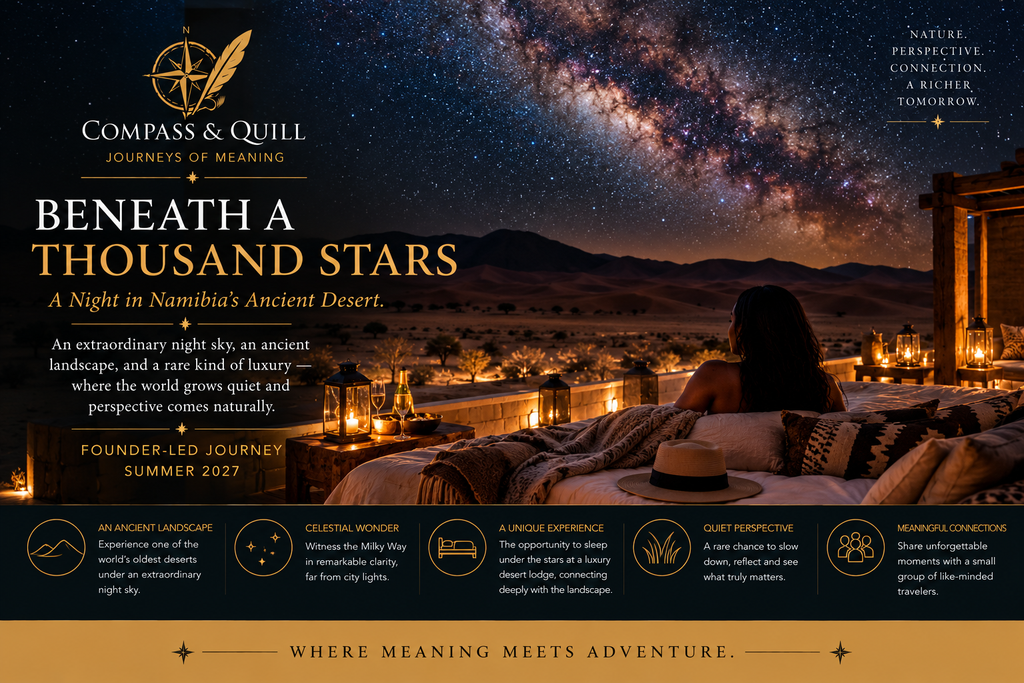
  • Beneath a Thousand Stars: A Night in Namibia’s Ancient Desert

    Beneath a Thousand Stars: A Night in Namibia’s Ancient Desert

    “Some of the world’s most extraordinary views appear only after the sun has disappeared.”

    There is a moment in the Namib Desert when the last light slips behind the dunes.

    The landscape begins to lose its color.

    The brilliant oranges and reds that defined the afternoon soften into muted shades of violet and charcoal.

    The air cools.

    The silence deepens.

    And overhead, something extraordinary begins to happen.

    One star appears.

    Then another.

    Then hundreds.

    Before long, the sky reveals a brilliance that many of us have almost forgotten exists.

    The Milky Way stretches across the darkness, and the ancient desert beneath it becomes part of something almost impossibly vast.

    This is Namibia after dark.

    And during our 2027 Compass & Quill Founder-Led Journey through Southern Africa, the desert night offers a completely different kind of wonder.

    Not an adventure measured by distance.

    An experience measured by how deeply we allow ourselves to be present.


    When the Desert Becomes Something Else

    By day, the Namib Desert is extraordinary.

    Its towering dunes rise above pale valleys and ancient riverbeds.

    The landscape shifts between burnt orange, crimson, and gold as sunlight moves across the sand.

    It is a place of remarkable contrasts.

    But nighttime reveals another dimension.

    Without the competing lights of a major city, the stars become the defining feature of the landscape.

    The sky no longer feels like something far above us.

    It feels immense.

    Surrounding.

    Almost close enough to touch.

    And for travelers accustomed to illuminated skylines, busy airports, and evenings spent beneath artificial light, the experience can be astonishing.

    We spend so much of our lives looking down at screens.

    Namibia gives us a reason to look up.


    One of the World’s Great Places to Experience Darkness

    The Namib is among the world’s oldest deserts, with landscapes shaped by geological and climatic processes extending back millions of years.

    Its remote location, arid climate, and relatively low levels of artificial light make parts of the region exceptional for observing the night sky.

    On a clear, moonless evening, the stars can appear with remarkable intensity.

    Constellations emerge.

    The Milky Way becomes visible as a luminous band across the darkness.

    And depending on the season and conditions, travelers may witness celestial details rarely visible from home.

    There is something extraordinary about realizing that the sky hasn’t changed nearly as much as our ability to see it has.

    The stars were always there.

    We simply stopped noticing them.


    Sleeping Beneath the African Sky

    At Little Kulala, one of the remarkable properties associated with our Namibia experience, the architecture is designed to connect guests with the surrounding desert.

    Its accommodations have featured rooftop sleeping arrangements that allow guests to experience the night sky from an extraordinary vantage point, subject to weather, operational arrangements, and guest preference.

    Imagine the possibility.

    The day’s adventures are complete.

    Dinner has been enjoyed.

    The desert has grown quiet.

    Instead of retreating entirely indoors, you settle into a beautifully prepared outdoor sleeping space.

    Above you is the African sky.

    No television.

    No illuminated city skyline.

    No constant movement beyond the windows.

    Only the stars.

    The stillness.

    And the extraordinary landscape surrounding you.

    For those who have spent years traveling between cities, meetings, hotels, and airports, the simplicity of such a night may feel surprisingly luxurious.

    Because sometimes the most remarkable accommodation is the one that allows the destination itself to become the experience.


    A Different Definition of Luxury

    Luxury is often measured by what has been added.

    More amenities.

    More technology.

    More entertainment.

    More elaborate surroundings.

    And certainly, exceptional hospitality depends on thoughtful details.

    But there are moments when luxury is defined by what has been removed.

    Noise.

    Crowds.

    Artificial light.

    Competing demands.

    The expectation that every moment must be filled.

    In the Namib Desert, the absence of those things becomes part of the privilege.

    You don’t need an elaborate production to appreciate the stars.

    You need darkness.

    A beautiful setting.

    Comfort.

    And enough time to look.

    That is an entirely different expression of luxury.

    And one that belongs naturally within the Compass & Quill philosophy.


    The Perspective of an Infinite Sky

    There is something about standing beneath an extraordinary night sky that changes our sense of proportion.

    The concerns that occupied our attention throughout the day begin to feel smaller.

    Not necessarily less important.

    Simply smaller in relation to everything around us.

    The universe has a remarkable way of reminding us that our individual experiences, ambitions, and challenges exist within a much larger story.

    For founders and executives, that perspective can be particularly meaningful.

    We spend our days making decisions.

    Building organizations.

    Managing responsibility.

    Thinking about the future.

    Often, we become so focused on what is immediately in front of us that we forget how much exists beyond it.

    Then we find ourselves standing in an ancient desert beneath a sky filled with stars.

    And suddenly, the world feels larger again.


    What Happens When There Is Nothing to Accomplish?

    Consider how much of modern life is organized around achievement.

    We measure progress.

    We establish goals.

    We create schedules.

    We monitor outcomes.

    Even leisure can become another exercise in optimization.

    How many destinations can we visit?

    How many experiences can we fit into one day?

    How many photographs can we capture?

    But the night sky cannot be hurried.

    There is no advantage to arriving at the stars before someone else.

    No prize for identifying the most constellations.

    No requirement to turn the experience into something productive.

    You simply observe.

    And perhaps that is part of its value.

    Not every meaningful moment needs to produce a measurable result.

    Some experiences matter because we were fully present for them.


    The Stories Written in the Stars

    For generations, communities across Africa have observed the night sky to understand seasons, navigate landscapes, and interpret the world around them.

    Astronomical knowledge has long existed alongside oral traditions, cultural practices, and practical knowledge of the natural environment.

    The stars were not merely beautiful.

    They were useful.

    They helped people understand time, movement, and seasonal change.

    Today, modern technology has transformed how we navigate and measure the world.

    But the sky remains a connection to generations who observed those same celestial patterns long before us.

    There is something deeply moving about that continuity.

    Travel invites us to encounter places through more than their physical beauty.

    It invites us to consider the people, knowledge, and traditions that give those places meaning.


    A Night That Requires Very Little

    Imagine the end of a day in Namibia.

    Perhaps we’ve explored the dunes of Sossusvlei.

    Perhaps we’ve watched the desert transform beneath the rising sun.

    Perhaps we’ve shared an extraordinary meal and spent the evening discussing the experiences of the day.

    Then the conversations quiet.

    The desert settles into darkness.

    And the stars take over.

    There is no need to organize another excursion.

    No need to prepare for an evening of entertainment.

    No need to fill the silence.

    For once, the most extraordinary thing happening requires absolutely nothing from us.

    It is simply there.

    Waiting to be noticed.


    The Beauty of Shared Silence

    One of the reasons our Founder-Led Journey is intentionally intimate is that meaningful connections develop in unexpected ways.

    Certainly, they happen through conversation.

    Around dinner tables.

    During excursions.

    Over shared discoveries.

    But connection can also happen in silence.

    Imagine sitting with fellow travelers beneath the Namibian sky.

    Someone notices a shooting star.

    Another points toward the Milky Way.

    A quiet conversation begins about the places we’ve visited and the experiences still ahead.

    And then, perhaps, nobody says anything at all.

    There is no discomfort in the silence.

    Only the shared understanding that everyone is witnessing something extraordinary.

    Some memories are built through conversation.

    Others are built through simply being together.


    Why the Night Matters as Much as the Day

    Our 2027 journey will offer remarkable experiences in daylight.

    The thunder of Victoria Falls.

    Elephants along the Chobe River.

    The waterways of the Okavango Delta.

    Namibia’s ancient dunes.

    Cape Town’s extraordinary landscapes and culinary traditions.

    But a journey should not lose its sense of discovery when the sun sets.

    Sometimes evening reveals an entirely different character of a destination.

    A river becomes golden.

    A city comes alive.

    A wilderness grows quiet.

    And in Namibia, the night sky becomes an experience in its own right.

    That contrast is part of what makes Southern Africa such an extraordinary region to explore.

    Every hour reveals something different.


    The Things We Cannot Take Home

    We can photograph the dunes.

    We can record the sound of Victoria Falls.

    We can bring home beautiful objects and carefully chosen souvenirs.

    But certain experiences resist being captured.

    The depth of the desert silence.

    The coolness of the night air.

    The feeling of looking into a sky so full of stars that it seems almost unreal.

    A photograph may remind us of the moment.

    It cannot entirely recreate it.

    And perhaps that is as it should be.

    Not everything extraordinary needs to be possessed.

    Some things are meant to be experienced, appreciated, and remembered.


    Looking Ahead to 2027

    Next June, sixteen travelers will embark on a carefully curated journey through Southern Africa.

    We will experience remarkable wildlife.

    Explore ancient landscapes.

    Discover vibrant cities.

    Share extraordinary meals.

    And enjoy hospitality designed to make each destination feel both exceptional and deeply personal.

    But somewhere in Namibia, after the day’s adventures have ended, another experience awaits.

    The desert will grow quiet.

    The stars will emerge.

    And for a little while, we will have nothing to do but look toward the heavens.

    No meetings.

    No deadlines.

    No decisions.

    Just an ancient landscape beneath an extraordinary sky.

    Perhaps years from now, when we think back on our journey, we’ll remember the helicopter flight over Victoria Falls or the elephants crossing the river.

    But perhaps we’ll also remember a quieter moment.

    A night in Namibia.

    The Milky Way overhead.

    And the realization that some of life’s greatest wonders have been waiting above us all along.

    Where Meaning Meets Adventure.

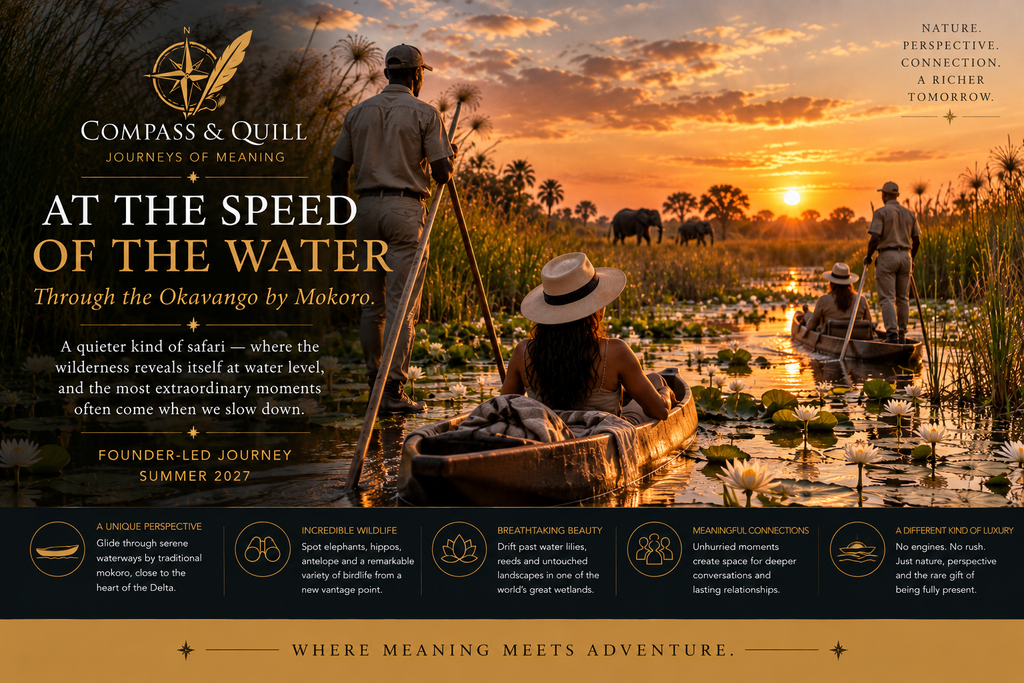
  • At the Speed of the Water: Through the Okavango by Mokoro

    At the Speed of the Water: Through the Okavango by Mokoro

    “There are places that cannot be rushed. The only way to truly experience them is to move at their pace.”

    The first thing you notice is what you don’t hear.

    No engine.

    No tires moving across gravel.

    No rush of wind.

    Instead, there is water.

    The call of a bird somewhere beyond the reeds.

    The occasional movement of something you cannot quite see.

    And the gentle sound of a pole entering the water as your mokoro glides forward.

    This is the Okavango Delta.

    But this time, we’re not observing it from the height of a safari vehicle.

    We’re moving through it almost at eye level with the water.

    Slowly.

    Quietly.

    And entirely on its terms.

    During our 2027 Compass & Quill Founder-Led Journey through Southern Africa, this may become one of the least dramatic experiences on the itinerary.

    It may also become one of the most memorable.


    First, What Exactly Is a Mokoro?

    A mokoro is a traditional dugout-style canoe associated with Botswana’s Okavango Delta.

    Historically carved from tree trunks, many used in tourism today are made from more sustainable materials designed to preserve the traditional form without requiring mature trees to be felled.

    Unlike a conventional boat powered by an engine, the mokoro is propelled by a skilled poler, who stands at the back and uses a long pole to guide the vessel through the Delta’s shallow channels.

    The result is an experience unlike almost any other form of safari.

    You don’t move quickly.

    You aren’t supposed to.


    Welcome to a Different Kind of Safari

    Most safari imagery is defined by distance.

    A vehicle stops.

    Binoculars rise.

    Cameras zoom.

    Wildlife is observed across the landscape.

    A mokoro changes that relationship.

    You are low.

    Close to the water.

    Reeds rise beside you.

    Water lilies appear almost within reach.

    Tiny frogs, insects, birds, and plants that might disappear into the background from a vehicle suddenly become part of the experience.

    The scale changes.

    And when the scale changes, so does your attention.

    You begin noticing smaller things.

    That may be one of the Delta’s greatest gifts.


    A River That Never Reaches the Sea

    The Okavango is unusual.

    Instead of flowing toward an ocean, the river travels inland and spreads across the sands of the Kalahari, creating an enormous wetland system in northern Botswana.

    Water arrives and transforms the landscape.

    Channels fill.

    Floodplains expand.

    Wildlife gathers.

    Vegetation responds.

    Then the water gradually recedes.

    The Delta breathes with the seasons.

    From above, its scale is extraordinary.

    From a mokoro, however, you experience something much more intimate.

    Not an ecosystem as a concept.

    An ecosystem happening around you.


    The Guide Sees What You Don’t

    One of the most humbling parts of traveling through wilderness is realizing how little most of us actually notice.

    A guide may stop because of a sound you didn’t hear.

    Point toward movement you never saw.

    Identify tracks that looked like marks in the mud.

    Recognize a bird from its call.

    Notice a change in the water.

    Read the landscape almost like a language.

    Expertise changes what is visible.

    Without it, we may look directly at something and never understand what we’re seeing.

    There is a lesson in that far beyond safari.

    Sometimes the difference between looking and understanding is simply knowing what deserves attention.


    At the Speed of the Water

    There will be moments on our Founder-Led Journey when we move quickly.

    Aircraft will carry us between countries.

    A helicopter will rise above Victoria Falls.

    Safari vehicles will take us across wilderness.

    Cities will introduce new energy.

    But the mokoro asks us to move differently.

    At the speed of the water.

    There is no overtaking.

    No rushing ahead.

    No attempt to squeeze one more experience into the hour.

    The landscape determines the pace.

    For people accustomed to controlling schedules, that surrender can feel unfamiliar.

    Perhaps that is exactly why we need it.


    Founders Are Trained to Accelerate

    Entrepreneurship celebrates speed.

    Move faster.

    Launch sooner.

    Respond immediately.

    Scale.

    Optimize.

    Accelerate.

    Sometimes speed is necessary.

    But speed also has a cost.

    When everything moves quickly, our field of vision narrows.

    We notice what is urgent.

    We miss what is subtle.

    The person whose tone changed during a meeting.

    The idea that isn’t fully formed yet.

    The opportunity hidden inside an unexpected conversation.

    The warning sign that wasn’t dramatic enough to demand immediate attention.

    A mokoro isn’t going to teach anyone how to run a company.

    But it may remind us of something leadership occasionally forgets:

    Not everything important announces itself loudly.


    What Happens When We Become Quiet

    The quieter we become, the more the Delta seems to reveal.

    Bird calls become distinct.

    Ripples attract attention.

    Movement among the reeds suddenly matters.

    The landscape that initially appeared peaceful begins to feel incredibly alive.

    Nothing changed.

    We did.

    Our attention sharpened.

    This is one of the reasons I believe meaningful travel can be so restorative.

    It changes what we pay attention to.

    And attention may be one of the most valuable resources we possess.


    The Luxury of Going Slowly

    Luxury travel is frequently associated with speed and convenience.

    Private transfers.

    Priority access.

    Shorter waits.

    Effortless connections.

    All of those things can make a journey more comfortable.

    But there is another kind of luxury.

    Having enough time that you don’t need to hurry.

    The mokoro represents that beautifully.

    We aren’t racing toward an attraction.

    We aren’t trying to cover maximum distance.

    The experience itself is the movement.

    There is nowhere else we need to get to.

    And suddenly, slow doesn’t feel inefficient.

    It feels privileged.


    Respecting the Wilderness

    An experience like this also reminds us that we are visitors.

    The Delta does not exist for our entertainment.

    It is a living ecosystem supporting wildlife and communities whose relationship with this landscape extends far beyond our brief time there.

    Responsible wilderness travel requires humility.

    We observe.

    We listen to our guides.

    We respect distance.

    We follow local expertise.

    And we leave knowing that the privilege was not simply seeing the Delta.

    It was being allowed to enter it.

    That distinction matters.


    The Moments Nobody Can Schedule

    Perhaps we’ll see elephants in the distance.

    Perhaps an antelope will appear near the water.

    Perhaps something extraordinary will happen that becomes the story everyone tells over dinner.

    Or perhaps nothing dramatic happens at all.

    We simply glide through reeds beneath an enormous Botswana sky.

    And that is enough.

    One of the things I love most about wilderness travel is that it refuses to perform on command.

    The itinerary can place us there.

    The guides can position us beautifully.

    But nature decides the rest.

    There is freedom in accepting that.


    Why This Experience Belongs on Our Journey

    The Founder-Led Journey isn’t designed to keep our travelers constantly stimulated.

    It is designed to create contrast.

    The thunder of Victoria Falls.

    The vastness of Namibia.

    The energy of Johannesburg.

    The elegance of Cape Town.

    The wildlife of Chobe.

    And here, in the Okavango Delta:

    Quiet.

    Every chapter contributes something different.

    The mokoro doesn’t need spectacle.

    Its power is intimacy.

    It brings us close enough to notice.


    What Will We Hear?

    I suspect that when we return home, some memories will arrive visually.

    A herd of elephants.

    The orange dunes of Namibia.

    Table Mountain.

    Victoria Falls.

    But perhaps this one will return as sound.

    Water moving beneath the mokoro.

    A pole slipping quietly into the channel.

    Birds calling from somewhere among the reeds.

    And then silence.

    The kind of silence that isn’t empty at all.

    It is full of things we finally slowed down enough to hear.


    Looking Ahead to 2027

    Next June, sixteen travelers will make their way into one of the world’s most remarkable inland wetlands.

    We’ll leave the engines behind.

    We’ll sit low against the water.

    We’ll follow narrow channels through the reeds.

    We’ll trust the people who understand this landscape far better than we do.

    And for a little while, we will move at a pace the modern world rarely permits.

    No acceleration.

    No optimization.

    No race toward what comes next.

    Just water.

    Wilderness.

    Attention.

    And the extraordinary discovery that sometimes slowing down doesn’t mean experiencing less.

    It allows us to experience more.

    Where Meaning Meets Adventure.
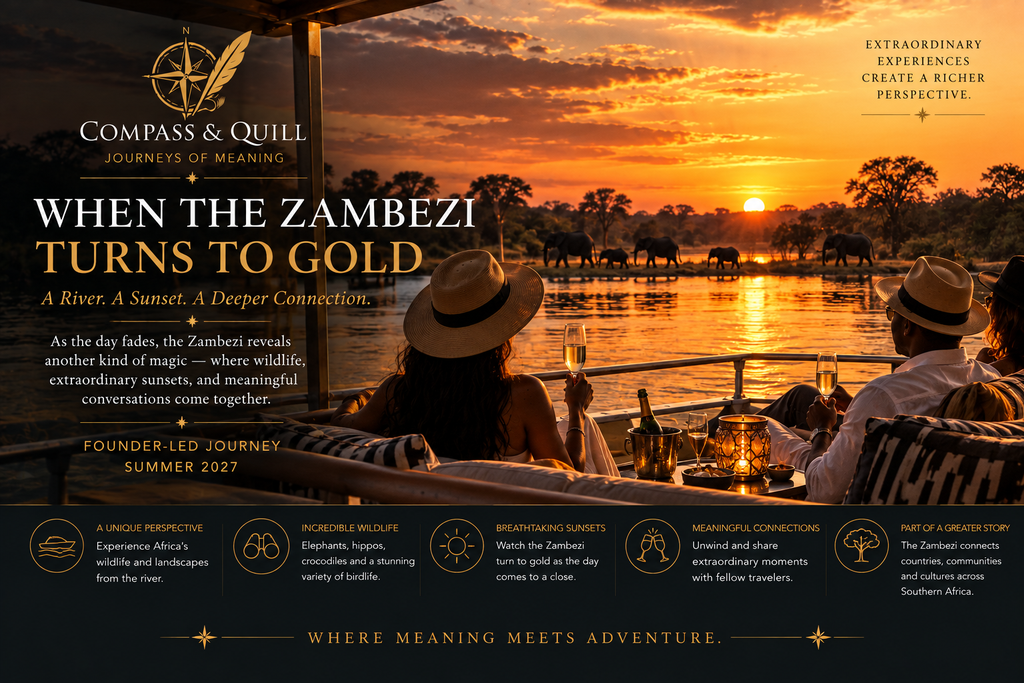
  • When the Zambezi Turns to Gold: An Evening on One of Africa’s Great Rivers

    When the Zambezi Turns to Gold: An Evening on One of Africa’s Great Rivers

    “Not every unforgettable moment announces itself. Some arrive quietly, somewhere between the fading light and the first stars.”

    There is a moment on the Zambezi when the entire landscape seems to change.

    The intensity of the afternoon begins to soften.

    The sky warms.

    The river catches the light.

    Birds move across the horizon while the shoreline becomes a silhouette.

    Somewhere in the distance, perhaps an elephant approaches the water.

    A hippo surfaces briefly, then disappears.

    And for a little while, there is nowhere else to be.

    This is another side of Zambia.

    Not the thunder of Victoria Falls.

    Not the adrenaline of seeing it from the sky.

    But the quieter rhythm of the river that creates it.

    During our 2027 Compass & Quill Founder-Led Journey through Southern Africa, an evening on the Zambezi gives us something every meaningful journey needs:

    time to simply take it all in.


    Before the Falls, There Is the River

    Victoria Falls receives much of the attention.

    Understandably so.

    But before the Zambezi reaches that dramatic precipice, it moves through Southern Africa as one of the continent’s great waterways.

    The river travels across a vast region, supporting ecosystems, communities, wildlife, agriculture, and livelihoods along the way.

    Near Livingstone, its character can appear surprisingly peaceful.

    Wide stretches of water.

    Small islands.

    Reeds along the shoreline.

    Birds moving overhead.

    The dramatic Falls may be nearby, but here the river feels almost contemplative.

    It is a reminder that power does not always announce itself loudly.

    Sometimes it flows quietly before revealing what it can do.


    Safari Looks Different From the Water

    By this stage of our journey, wildlife will already have begun entering the story.

    But experiencing Africa from a river changes the perspective.

    There is no road.

    No predetermined path through the landscape.

    The water becomes the route.

    From the boat, our attention shifts naturally toward the banks.

    We watch.

    We listen.

    We wait.

    Perhaps elephants appear near the shoreline.

    Perhaps crocodiles rest along the bank.

    Perhaps hippos remind us—with appropriate distance—that the river belongs to them far more than it belongs to us.

    And then there are the birds.

    Southern Africa’s waterways support extraordinary birdlife, and even travelers who have never considered themselves birdwatchers often find themselves suddenly paying attention.

    The river slows us down enough to notice.


    Then Someone Pours a Drink

    There is something wonderfully civilized about watching the African wilderness unfold with a glass in hand.

    Not because the drink is the point.

    It isn’t.

    The point is the pause.

    The conversation.

    The realization that nobody needs to rush back to anything.

    We are exactly where we are supposed to be.

    Perhaps someone begins telling a story.

    Another guest notices movement along the shoreline.

    Conversation stops for a moment.

    Everyone turns.

    Then the conversation resumes.

    This is how some of the best travel memories are created.

    Not through constant spectacle.

    Through atmosphere.


    Founders Are Usually Looking Ahead

    Founders have an occupational habit.

    We live slightly ahead of the present.

    What happens next?

    What needs to be built?

    What needs fixing?

    What opportunity are we missing?

    What happens next quarter?

    Next year?

    Five years from now?

    That forward orientation can be extraordinarily useful.

    It is also exhausting.

    Travel occasionally gives us permission to ask a different question:

    What is happening right now?

    Not tomorrow.

    Not after we return.

    Not when the next milestone is reached.

    Right now.

    The Zambezi at sunset is a remarkably good place to practice answering that question.


    The Golden Hour

    Eventually, the light begins doing what African light does so beautifully.

    Everything warms.

    The river turns from blue to gold.

    Trees become silhouettes.

    Clouds catch shades of amber, rose, and copper.

    The entire landscape seems briefly illuminated from within.

    Photographs will be taken.

    Of course they will.

    But there comes a point when the camera should probably be lowered.

    Because some moments are diminished when we spend the entire experience trying to preserve them.

    There is value in allowing memory to do some of the work.


    What Happens When the Conversation Deepens

    One of the reasons our Founder-Led Journey is intentionally limited to a small group is that meaningful connection takes time.

    It rarely happens during introductions.

    It happens gradually.

    After shared experiences.

    After meals.

    After unexpected moments.

    After people begin lowering their professional guard.

    A river at sunset creates exactly the kind of environment where conversation changes.

    Someone asks a better question.

    Someone shares something they weren’t planning to share.

    An idea surfaces.

    A friendship begins.

    A business conversation may emerge.

    Or perhaps nobody talks about business at all.

    That is perfectly fine too.

    Not every relationship needs an agenda.


    Luxury Without Walls

    We often associate luxury with interiors.

    Beautiful suites.

    Exceptional restaurants.

    Elegant lounges.

    Thoughtful design.

    And throughout our journey, those elements matter.

    But some of Southern Africa’s most luxurious rooms have no walls at all.

    A boat on the Zambezi.

    An open sky.

    A river stretching toward the horizon.

    Wildlife along the shoreline.

    A sunset nobody can reserve exclusively.

    The experience reminds us that exceptional hospitality doesn’t always require elaborate surroundings.

    Sometimes the surroundings are already extraordinary.

    The luxury is simply being positioned to appreciate them.


    A River Connecting More Than Landscapes

    The Zambezi is also a reminder that the countries on our itinerary are not isolated destinations.

    Rivers cross borders.

    Wildlife moves across borders.

    Communities have histories that long predate modern boundaries.

    Trade crosses borders.

    Culture crosses borders.

    Ideas cross borders.

    Our journey will move through several Southern African countries, but the deeper story is one of connection.

    The Zambezi makes that visible.

    Water moves.

    People move.

    Stories move.

    And travel allows us to follow them.


    Why This Moment Belongs on the Journey

    Our itinerary contains experiences designed to astonish.

    Victoria Falls will do that.

    Safari will do that.

    The Namib Desert will do that.

    But a journey composed entirely of extraordinary spectacle eventually becomes exhausting.

    There must be rhythm.

    Excitement.

    Stillness.

    Discovery.

    Reflection.

    Conversation.

    Celebration.

    Rest.

    An evening on the Zambezi creates a pause between chapters.

    It allows us to experience Southern Africa without trying to conquer it.


    When Day Becomes Night

    Eventually, the sun disappears.

    The brilliant colors soften.

    The air cools.

    Lights begin appearing in the distance.

    Perhaps the first stars emerge overhead.

    And the boat begins its return.

    There is usually something different about people after a beautiful sunset.

    Conversation becomes quieter.

    Nobody seems particularly interested in checking the time.

    The day feels complete.

    Nothing spectacular needs to happen next.

    That feeling is increasingly rare.

    And perhaps that is why we remember it.


    The Compass & Quill Philosophy

    At Compass & Quill, we aren’t designing a journey around the idea that every hour must be maximized.

    We’re designing one around the idea that every chapter should have meaning.

    Sometimes meaning arrives through history.

    Sometimes through adventure.

    Sometimes through extraordinary wildlife.

    Sometimes through conversation.

    And sometimes it arrives while sitting quietly on a river as the sun disappears over Africa.

    Those quieter moments matter.

    Perhaps more than we realize.


    Looking Ahead to 2027

    Next June, our travelers will experience the Zambezi in dramatically different ways.

    We’ll hear its power at Victoria Falls.

    We’ll see its landscape from above.

    And then we’ll encounter another version of the river.

    Calm.

    Golden.

    Unhurried.

    We’ll board a boat as afternoon begins to fade.

    We’ll watch the banks for wildlife.

    We’ll share a drink.

    We’ll talk.

    We’ll watch the sky change.

    And for one evening, nobody will need to think about what comes next.

    Because sometimes the most meaningful part of a journey is not where you’re going.

    It’s realizing how extraordinary it is to be exactly where you are.

    Where Meaning Meets Adventure.
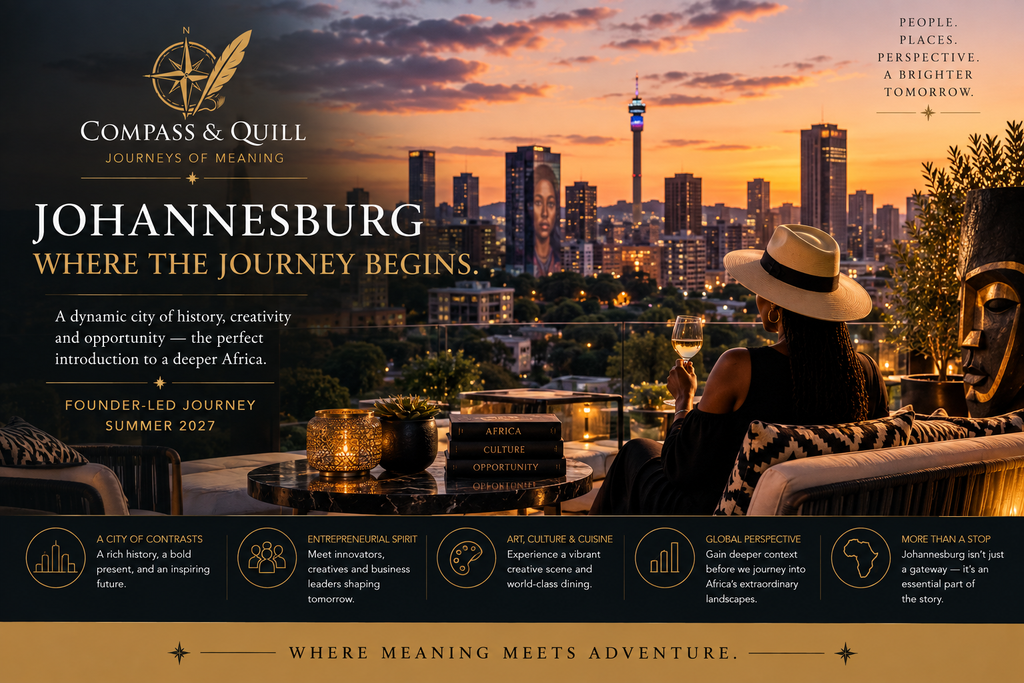
  • Johannesburg: Where the Journey Begins

    Johannesburg: Where the Journey Begins

    “Before we venture into the wild, we begin in a city that understands what it means to build, rebuild, and imagine what comes next.”

    Every journey has a beginning.

    Not simply the place where the plane lands or the luggage arrives.

    A true beginning establishes the tone for everything that follows.

    For our 2027 Compass & Quill Founder-Led Journey through Southern Africa, that beginning is Johannesburg.

    It would have been easy to treat Johannesburg as a gateway.

    Arrive.

    Rest.

    Continue onward.

    But that would miss the point entirely.

    Johannesburg is not merely somewhere we pass through on our way to Africa’s celebrated wilderness.

    It is part of the story.

    A complicated, energetic, creative city shaped by history and constantly imagining its future.

    And for a journey created especially for founders, entrepreneurs, executives, and curious travelers, I can think of few more appropriate places to begin.


    Africa Beyond the Safari

    For many international travelers, the imagery associated with Southern Africa begins with wildlife.

    Elephants crossing rivers.

    Lions resting beneath acacia trees.

    Crimson dunes stretching toward the horizon.

    Those images are real, and we’ll experience many of them.

    But Africa cannot be understood only through its wilderness.

    It is also urban.

    Creative.

    Entrepreneurial.

    Architectural.

    Culinary.

    Technological.

    Young.

    Ambitious.

    Johannesburg introduces us to that Africa.

    It gives our travelers an opportunity to encounter the continent not merely as observers of extraordinary landscapes, but as visitors to one of its great modern cities.


    A City Built on Reinvention

    Johannesburg is relatively young by the standards of the world’s major cities.

    Its extraordinary growth began with the discovery of gold in the late nineteenth century.

    Almost overnight, people arrived seeking possibility.

    Fortunes were created.

    Industries emerged.

    Infrastructure expanded.

    Communities formed.

    And the city that would become Johannesburg began taking shape.

    But its history is also inseparable from South Africa’s painful history of racial segregation and apartheid.

    The Johannesburg of today carries those histories simultaneously.

    Prosperity and inequality.

    Memory and ambition.

    Old divisions and new possibilities.

    It is precisely this complexity that makes the city worth experiencing.

    Meaningful travel should not flatten destinations into beautiful photographs.

    It should allow them to remain complicated.


    Understanding Before Exploring

    There is something important about beginning our Southern Africa journey with context.

    Before the safaris.

    Before the waterfalls.

    Before the desert.

    Before the vineyards.

    We encounter history.

    Because landscapes tell only part of a country’s story.

    People tell the rest.

    Johannesburg provides an opportunity to better understand the forces that shaped modern South Africa and the extraordinary transformation the country has experienced within living memory.

    That understanding changes what comes afterward.

    Cape Town looks different when you understand more of South Africa’s history.

    Conversations become richer.

    Observations become more informed.

    Travel becomes more than consumption.

    It becomes education.


    The Africa That Is Building

    But Johannesburg is not only a city of history.

    It is also a city deeply concerned with the future.

    Across the metropolitan area, entrepreneurs, artists, designers, chefs, technologists, investors, and creatives are building businesses and reshaping industries.

    That is one of the dimensions of Africa I am particularly excited for our guests to encounter.

    Because the global conversation about Africa too often focuses on either its challenges or its natural beauty.

    There is another story unfolding simultaneously.

    A story about enterprise.

    Innovation.

    Creativity.

    Investment.

    And opportunity.

    For founders traveling with Compass & Quill, those conversations matter.


    What Founders Notice Differently

    Entrepreneurs have an interesting habit when they travel.

    We notice businesses.

    A beautifully designed restaurant becomes a conversation about hospitality.

    A local brand becomes a lesson in positioning.

    A neighborhood undergoing transformation becomes a discussion about investment.

    A conversation with an entrepreneur quickly becomes an exchange of ideas.

    We cannot help ourselves.

    We are constantly asking:

    How did they build this?

    Why does this work?

    What opportunity did they see that others missed?

    What could happen next?

    Johannesburg rewards that curiosity.

    Because beneath its enormous scale is a city filled with people building things.

    And builders tend to recognize one another.


    Creativity as a Language

    One of Johannesburg’s most compelling qualities is its creative energy.

    Art, fashion, design, music, food, and architecture provide different ways of understanding the city.

    Creative communities have transformed spaces and neighborhoods, using culture not simply as entertainment but as commentary, identity, enterprise, and expression.

    For travelers, this offers another way into the destination.

    History tells us what happened.

    Creativity often tells us how people feel about what happened—and what they imagine could happen next.

    That distinction matters.


    The Conversations Between the Experiences

    Our Founder-Led Journey isn’t designed around nonstop programming.

    There will be extraordinary scheduled experiences.

    But I am equally interested in what happens between them.

    Over breakfast.

    During dinner.

    In the hotel lounge.

    On the drive back from an experience.

    Perhaps someone notices a business model.

    Someone else recognizes an investment trend.

    Another traveler sees a cultural connection.

    A conversation begins.

    That conversation continues later.

    And suddenly a destination has created an idea none of us had before arriving.

    This is one of the reasons we are intentionally keeping the journey intimate.

    Meaningful conversations need room to develop.


    Starting With Curiosity

    There is another reason Johannesburg belongs at the beginning.

    It asks travelers to arrive curious.

    Not assuming we already understand Africa.

    Not expecting the continent to conform to familiar narratives.

    Not simply looking for the photographs we’ve seen before.

    Curious.

    About the people.

    The history.

    The businesses.

    The neighborhoods.

    The food.

    The ideas.

    The contradictions.

    The possibilities.

    That mindset will serve us throughout the entire journey.


    Then the Landscape Changes

    Eventually, we leave Johannesburg.

    The city begins to recede.

    And the rhythm of the journey changes dramatically.

    Ahead are waterfalls.

    Rivers.

    Wildlife.

    Deserts.

    Mountains.

    Vineyards.

    Extraordinary lodges.

    Quiet mornings.

    Long dinners.

    And landscapes that will make many of us forget our phones entirely.

    But Johannesburg will have given us something important before we go.

    Context.

    We won’t simply be traveling through Southern Africa.

    We will have begun learning something about it.


    Why Our Journey Begins Here

    Every destination on the Compass & Quill Founder-Led Journey has a role to play.

    Victoria Falls gives us awe.

    Chobe gives us encounter.

    The Okavango Delta gives us immersion.

    Namibia gives us perspective.

    Cape Town gives us celebration and restoration.

    Johannesburg gives us context.

    It reminds us that Africa’s story is not confined to the past.

    Nor is it confined to the wilderness.

    It is being written every day in offices, studios, kitchens, workshops, universities, neighborhoods, and businesses across the continent.

    And that is a story worth encountering.


    Looking Ahead to 2027

    Next June, a small group of travelers will arrive in Johannesburg carrying luggage, expectations, and perhaps a few assumptions.

    That’s how most journeys begin.

    But the best travel gradually changes what we think we know.

    Over the following 21 days, we’ll move through multiple countries and experience some of Southern Africa’s most extraordinary places.

    We’ll witness things photographs cannot capture.

    We’ll meet people we did not know before.

    We’ll share tables.

    We’ll exchange ideas.

    We’ll experience moments of exhilaration and moments of complete stillness.

    And perhaps we’ll return home seeing this part of the world – and our own place within it – a little differently.

    But first, Johannesburg.

    A city built through ambition, tested by history, shaped by reinvention, and still becoming.

    For a journey created for people who understand something about building, I can’t imagine a more fitting place to begin.

    Where Meaning Meets Adventure.

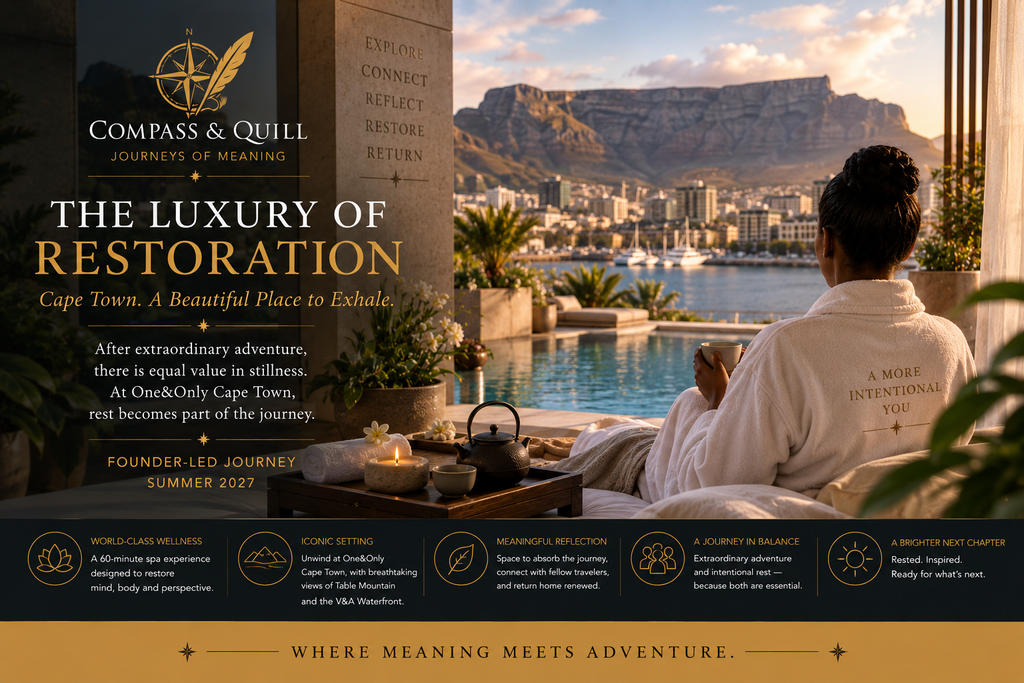
  • The Luxury of Restoration: Why Our Journey Ends With Time to Exhale

    The Luxury of Restoration: Why Our Journey Ends With Time to Exhale

    “A remarkable journey should not leave you needing a vacation from your vacation.”

    For nearly three weeks, we will have been moving through some of Southern Africa’s most extraordinary landscapes.

    We will have stood beside the thunder of Victoria Falls.

    Watched elephants gather along the Chobe River.

    Explored Botswana’s wilderness.

    Floated above Namibia’s ancient desert at sunrise.

    Walked among the haunting landscapes of Sossusvlei and Deadvlei.

    Shared extraordinary meals, conversations, discoveries, and experiences.

    And then, as our 2027 Compass & Quill Founder-Led Journey reaches Cape Town, we’re going to do something that may seem surprisingly simple.

    We’re going to stop.

    Not because we’ve run out of things to experience.

    Because rest is part of the experience.


    The Problem With Coming Home Exhausted

    We’ve all experienced that kind of travel.

    Every day is packed.

    Every hour is scheduled.

    There is always another excursion, another restaurant, another landmark, another early departure.

    You return home with hundreds of photographs – and an overwhelming desire to sleep for three days.

    Somewhere along the way, we began treating travel like another form of productivity.

    How much can we fit in?

    How many places can we see?

    How much value can we extract from every day?

    But meaningful travel should not feel like another performance metric.

    Especially for people whose everyday lives already demand so much of them.

    That is why restoration isn’t an afterthought on our Founder-Led Journey.

    It is part of the design.


    Our Final Chapter at One&Only Cape Town

    Our journey concludes at One&Only Cape Town, overlooking the Victoria & Alfred Waterfront beneath the unmistakable presence of Table Mountain.

    By the time we arrive, we will have traveled through multiple countries and experienced everything from waterfalls and wildlife to deserts and cities.

    Cape Town becomes our place to land.

    To settle.

    To enjoy exceptional hospitality without feeling compelled to immediately move on to the next thing.

    And as part of that experience, our guests will have time dedicated specifically to wellness and restoration.

    A 90-minute spa treatment may appear modest compared with flying over Victoria Falls or floating above the Namib Desert in a balloon.

    But that is precisely the point.

    Not every extraordinary experience needs adrenaline.


    What If Doing Nothing Is Actually Doing Something?

    Founders are not particularly good at doing nothing.

    Neither are many executives.

    There is always another decision.

    Another email.

    Another problem.

    Another opportunity.

    Another idea that arrives at precisely the moment you’re supposed to be resting.

    Even vacations can become mobile offices with better scenery.

    But eventually, the body notices what the calendar ignores.

    Travel creates a rare opportunity to interrupt that pattern.

    A quiet treatment room.

    An hour and a half without a phone.

    No decisions.

    No conversation required.

    No responsibility for what happens next.

    Just stillness.

    That isn’t wasted time.

    It may be some of the most valuable time on the entire journey.


    Restoration Is Different From Indulgence

    Wellness is sometimes presented as another luxury amenity.

    We see photographs of beautiful spas, pools, robes, candles, and treatment rooms.

    But restoration is deeper than aesthetics.

    It is about creating enough space for your nervous system to recognize that nothing is currently required of you.

    That distinction matters.

    For people who spend much of their lives carrying responsibility—for businesses, employees, clients, families, investments, and communities—true rest can become surprisingly unfamiliar.

    There is an important difference between being away from work and actually resting.

    We want our guests to experience the latter.


    Why We Put This Near the End

    The placement is intentional.

    Imagine everything we will have experienced by the time we reach Cape Town.

    There will be memories competing for attention.

    Stories already being retold.

    Thousands of photographs.

    New friendships.

    Unexpected conversations.

    Perhaps new ideas.

    Perhaps even new perspectives about what comes next after returning home.

    Before everyone boards a flight and immediately re-enters normal life, there should be space to absorb some of it.

    Because reflection is how experience becomes meaning.

    Without reflection, even extraordinary moments can blur together.


    The Founder Who Never Stops

    There is an interesting contradiction in entrepreneurship.

    Many people build businesses because they want freedom.

    Then they become indispensable to the businesses they created.

    The company needs them.

    The team needs them.

    The clients need them.

    Their inbox needs them.

    Eventually, stepping away can feel irresponsible.

    But leadership without restoration has a cost.

    Perspective narrows.

    Creativity declines.

    Decision fatigue accumulates.

    Everything begins to feel urgent.

    Sometimes physical distance creates the space necessary to recognize what we could not see while standing in the middle of our normal routines.

    And sometimes rest reveals answers that effort couldn’t produce.


    Imagine the Afternoon

    You’ve just returned from exploring Cape Town.

    Table Mountain rises beyond the city.

    The waterfront moves at its own rhythm outside.

    But for the next hour and a half, none of that requires your attention.

    Your phone is somewhere else.

    There is no meeting afterward.

    No presentation to prepare.

    No itinerary you need to manage.

    Someone else has thought about the details.

    Your only responsibility is to receive the experience.

    Afterward, perhaps you sit quietly with tea.

    Perhaps you return to your room.

    Perhaps you meet fellow travelers later for dinner and realize the conversation feels different now.

    Slower.

    More reflective.

    More present.

    That is luxury too.


    The Difference Between Escape and Renewal

    I don’t believe the best travel helps us escape our lives.

    If we need to escape our lives, perhaps there are larger questions waiting for us at home.

    The best travel gives us enough distance to return to our lives differently.

    Rested.

    Inspired.

    Curious.

    Clearer.

    Grateful.

    Maybe even brave enough to change something that no longer fits.

    That is renewal.

    And it is one of the reasons Compass & Quill was created around journeys of meaning, rather than simply luxury vacations.


    Luxury Is Having Nothing Required of You

    We often define luxury by what is provided.

    A beautiful suite.

    Exceptional service.

    Private transportation.

    Fine dining.

    Exclusive access.

    But perhaps one of the greatest luxuries is defined by what is temporarily removed.

    Urgency.

    Responsibility.

    Noise.

    Decision-making.

    Expectation.

    For one and a half hour in Cape Town, there is nowhere else our guests need to be.

    Nothing they need to accomplish.

    Nothing they need to prove.

    There is simply permission to stop.


    The Journey Home Begins Before the Airport

    Eventually, every extraordinary journey ends.

    Suitcases are repacked.

    Photographs are organized.

    Contact information is exchanged.

    Promises are made to stay connected.

    And flights begin carrying everyone home.

    But I don’t want our guests’ transition home to begin at the airport.

    I want it to begin quietly in Cape Town.

    With time to reflect on what they saw.

    What surprised them.

    Who they met.

    What they learned.

    What they want to carry home.

    And perhaps what they are ready to leave behind.

    Because returning is part of traveling too.


    Looking Ahead to 2027

    Next June, our Founder-Led Journey will contain moments of extraordinary movement.

    Helicopters.

    Safari vehicles.

    Boats.

    Private regional flights.

    A hot-air balloon.

    And eventually, the long flight home.

    But one of the moments I’m most looking forward to may involve no movement at all.

    An hour and a half in Cape Town.

    A quiet room.

    A phone set aside.

    And sixteen travelers given permission to simply exhale.

    Because sometimes the most luxurious thing we can give ourselves isn’t another experience.

    It’s enough stillness to appreciate all the experiences we’ve already had.

    Where Meaning Meets Adventure.

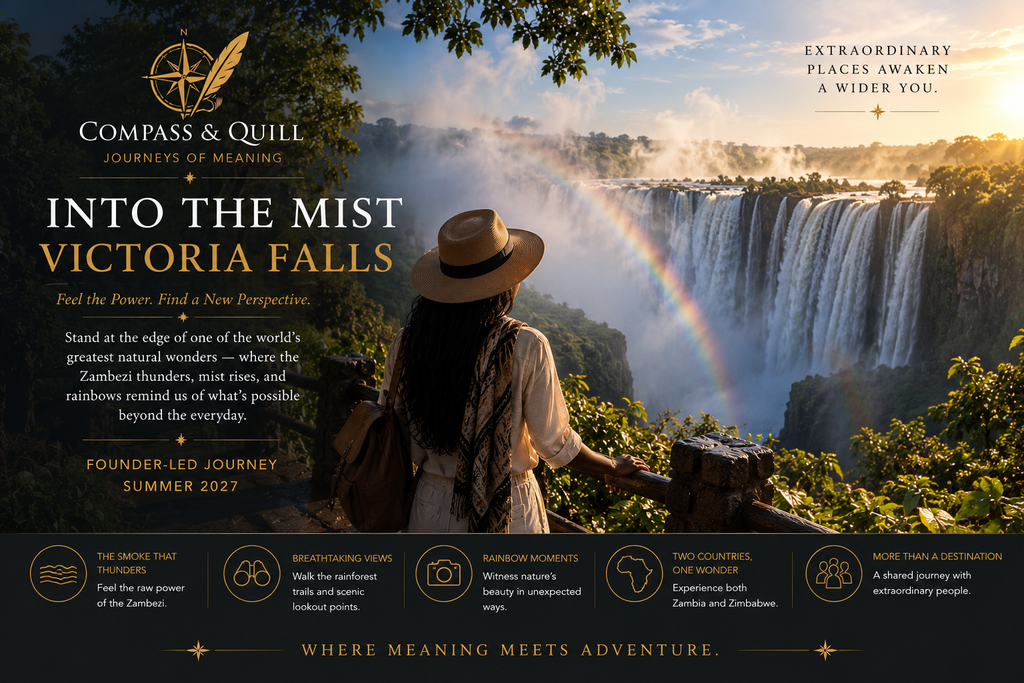
  • Into the Mist: Standing at the Edge of Victoria Falls

    Into the Mist: Standing at the Edge of Victoria Falls

    “Some places are meant to be seen. Others demand to be felt.”

    Long before you see Victoria Falls, you may hear it.

    A distant roar rises above the landscape.

    Then comes the mist.

    It hangs in the air, drifts above the trees, catches the sunlight, and announces that somewhere just ahead, the Zambezi River is doing something extraordinary.

    Then you reach the edge.

    Suddenly, the photographs you’ve seen no longer seem adequate.

    An immense curtain of water disappears into a gorge below. Mist rises back toward the sky. Rainbows form and vanish. The sound surrounds you.

    This is Mosi-oa-Tunya.

    The Smoke That Thunders.

    And during our 2027 Compass & Quill Founder-Led Journey through Southern Africa, we won’t simply fly above this extraordinary landscape.

    We’ll step into it.


    Where a River Disappears

    For much of its journey toward Victoria Falls, the Zambezi appears deceptively calm.

    Broad stretches of water move through the landscape, dotted with islands and surrounded by vegetation.

    Then the geology changes everything.

    The river reaches a vast fracture in the basalt plateau and plunges dramatically into the narrow gorge below.

    From the walking paths, you don’t experience this as a distant panorama.

    You are remarkably close to it.

    You hear the force of the water.

    You feel moisture against your skin.

    Depending on seasonal conditions, the mist can become so intense that walking near the Falls feels like stepping into a sudden tropical rainstorm.

    Nature stops being scenery.

    It becomes immersive.


    Why We Need Both Perspectives

    Earlier, we shared another extraordinary experience awaiting our travelers: seeing Victoria Falls from a helicopter.

    From above, you understand its scale.

    You see the Zambezi approaching the precipice.

    You see the gorges carved into the landscape.

    You understand how the Falls fit within a much larger geological story.

    But standing beside them offers something the sky cannot.

    You feel their power.

    The two perspectives complement one another beautifully.

    One provides distance.

    The other provides intimacy.

    And perhaps there is a lesson there.

    Sometimes we need to rise above something to understand it.

    Other times, we need to stand close enough to feel it.


    The Smoke That Thunders

    The indigenous name for Victoria Falls may be one of the most evocative descriptions of a natural wonder anywhere in the world.

    Mosi-oa-Tunya.

    The Smoke That Thunders.

    It describes precisely what happens here.

    From a distance, the immense spray resembles smoke rising above the landscape.

    Up close, the roar of falling water becomes almost physical.

    The name reminds us of something important about travel:

    Places already have stories before we arrive.

    Names.

    Meanings.

    Histories.

    Ways of understanding the landscape that existed long before it appeared on an international travel itinerary.

    Meaningful travel asks us to encounter those stories—not simply the attraction.


    The Rainbows

    Then there are the rainbows.

    Sunlight passing through the mist can produce brilliant arcs of color across the gorge.

    Sometimes one appears.

    Sometimes several.

    Sometimes they emerge for only a moment before disappearing again.

    You cannot schedule them.

    You cannot ask nature to hold the light while everyone gets the perfect photograph.

    You simply have to be paying attention.

    That unpredictability is one of the things I love about experiences like this.

    The itinerary can bring us to the right place.

    But the moment itself still belongs to nature.


    When Awe Makes Us Quiet

    Founders spend a remarkable amount of time being responsible for answers.

    What should we do next?

    How do we solve this?

    What happens if the plan changes?

    Where should we invest?

    Who needs a decision?

    Leadership requires constant mental activity.

    Awe interrupts it.

    Stand before something powerful enough, ancient enough, or beautiful enough, and for a few moments there is nothing to solve.

    You simply look.

    That experience has value.

    Researchers have increasingly explored the relationship between awe and our perception of ourselves within something larger.

    Travel has always understood this intuitively.

    Sometimes we need encounters that remind us the world is much bigger than the problems occupying our calendars.

    Victoria Falls does that exceptionally well.


    A Journey Through Two Countries

    Victoria Falls also occupies a fascinating geographic position along the border between Zambia and Zimbabwe.

    And our Founder-Led Journey intentionally includes both countries.

    That matters because borders may divide maps, but landscapes rarely behave so neatly.

    The Zambezi connects ecosystems, communities, histories, and economies across Southern Africa.

    Experiencing this region encourages us to think beyond individual destinations.

    We begin to see Southern Africa not as a collection of isolated stops, but as an interconnected story.

    Waterways cross boundaries.

    Wildlife crosses boundaries.

    Cultures influence one another.

    History crosses boundaries.

    And travelers do too.


    Why This Belongs on the Founder-Led Journey

    Our journey was never designed around simply collecting famous places.

    Victoria Falls certainly deserves its place on any list of the world’s great natural wonders.

    But that isn’t why it belongs here.

    It belongs because of what it contributes to the rhythm of the journey.

    Awe.

    Before Botswana asks us to become still…

    Before Namibia gives us space to reflect…

    Before Cape Town invites us to celebrate…

    Victoria Falls reminds us what it feels like to be completely astonished.

    There is value in beginning a journey that way.


    The Luxury of Being Fully Present

    Luxury travel is often discussed in terms of accommodations, transportation, dining, and service.

    Those things matter.

    We have intentionally chosen exceptional properties and experiences throughout this journey.

    But there is another form of luxury that cannot be purchased quite so easily.

    Undivided attention.

    Standing beside Victoria Falls while thinking about emails would almost feel absurd.

    The landscape demands your presence.

    The sound.

    The mist.

    The movement.

    The scale.

    Everything conspires to pull you into the moment.

    And perhaps that is one of the reasons we travel so far from home.

    Sometimes distance helps us become present again.


    What Will You Remember?

    Years after a journey like this, details inevitably fade.

    You may forget what you ordered for dinner on a particular evening.

    You may forget the exact departure time of a flight.

    You may even forget the name of an excursion.

    But you probably won’t forget the first time you stood beside Victoria Falls.

    You’ll remember the roar.

    The mist.

    The rainbow that appeared unexpectedly.

    The person standing beside you.

    The feeling of realizing that something you had seen countless times in photographs was suddenly right there.

    Real.

    Immense.

    Alive.

    Those are the moments that become part of our personal history.


    Looking Ahead to 2027

    Next June, our travelers will experience Victoria Falls from more than one perspective.

    We’ll see its extraordinary scale from the sky.

    Then we’ll come back to earth and stand close enough to feel its power.

    Afterward, the journey continues.

    Botswana.

    Namibia.

    Cape Town.

    Safari, desert, culture, food, conversation, reflection, and extraordinary hospitality.

    But before all of that, there will be this moment.

    Standing beside the Zambezi.

    Mist in the air.

    Thunder rising from the gorge.

    And sixteen travelers realizing that the journey they’ve imagined for months has truly begun.

    Some destinations welcome you quietly.

    Victoria Falls makes an entrance.

    And we wouldn’t want to begin this adventure any other way.

    Where Meaning Meets Adventure.

  • Where Time Stands Still: Walking the Ancient Landscapes of Sossusvlei

    “Some places show us how beautiful the world is. Others remind us just how briefly we are passing through it.”

    There are landscapes that look familiar even when you have never visited them.

    And then there is Sossusvlei.

    Imagine towering dunes rising from the desert floor in shades of burnt orange and crimson.

    An impossibly blue African sky.

    Brilliant white clay pans stretching beneath your feet.

    And, standing against it all, the dark silhouettes of ancient trees that stopped growing centuries ago but remain preserved by one of the driest environments on Earth.

    It almost doesn’t look real.

    Yet this remarkable corner of Namibia is very real—and next year, it becomes another chapter in our Compass & Quill Founder-Led Journey through Southern Africa.

    We have already shared what it will be like to float above the Namib Desert at sunrise.

    This time, we’re coming back down to earth.

    Because some landscapes deserve to be walked.


    Welcome to Sossusvlei

    Deep within Namibia’s Namib-Naukluft region lies Sossusvlei, one of Africa’s most recognizable desert landscapes.

    Here, enormous sand dunes surround pale clay pans formed over thousands of years as the desert gradually changed the course of the Tsauchab River.

    The scale is difficult to appreciate in photographs.

    Some of the dunes rise hundreds of meters above the desert floor.

    Their ridgelines shift with the wind.

    Their colors change throughout the day.

    At sunrise, one side may glow brilliant orange while the other remains almost completely in shadow.

    By midday, the entire landscape has transformed.

    The desert is never truly still.

    Even when it appears to be.


    Then You Reach Deadvlei

    Not far from Sossusvlei is a place that feels almost otherworldly.

    Deadvlei.

    Centuries ago, water from the Tsauchab River reached this clay pan, allowing camel thorn trees to grow.

    Then the climate changed.

    The dunes shifted.

    Water stopped reaching the area.

    The trees died.

    But the extreme dryness prevented them from decomposing.

    And so they remain.

    Blackened trunks standing against white earth.

    Surrounded by enormous red dunes.

    Beneath a brilliant blue sky.

    Some of these trees are believed to have been standing here, preserved by the desert, for hundreds of years.

    There is something almost haunting about them.

    But there is also something extraordinarily beautiful.


    A Landscape That Changes Your Sense of Time

    Modern life teaches us to measure almost everything in minutes.

    Meetings.

    Deadlines.

    Flights.

    Appointments.

    Productivity.

    We organize our lives around calendars and clocks.

    Then you stand somewhere like Deadvlei.

    The dunes around you have been forming for thousands upon thousands of years.

    The desert itself is tens of millions of years old.

    Trees that died centuries ago still stand before you.

    Suddenly, the urgency of Tuesday afternoon feels remarkably small.

    That is one of travel’s greatest gifts.

    It changes scale.

    Not only geographically.

    Emotionally.

    It reminds us that the world existed long before our problems arrived—and will continue long after they have passed.


    The Climb

    For those who choose to experience Namibia’s dunes on foot, there is another lesson waiting.

    Climbing a sand dune looks deceptively simple.

    It isn’t.

    Every step sinks.

    The ridge continues farther than expected.

    Progress becomes slow and deliberate.

    You stop trying to rush.

    Eventually, you find your rhythm.

    Step.

    Breathe.

    Step.

    Breathe.

    And then you reach the top.

    Below you, the desert unfolds in every direction.

    The reward isn’t simply the view.

    It’s knowing you earned the perspective.

    Perhaps there is something familiar about that for founders.

    The most worthwhile things rarely happen quickly.


    Why This Experience Belongs on a Founder-Led Journey

    There is a reason we call this a Founder-Led Journey rather than simply a luxury vacation.

    Yes, we want extraordinary accommodations.

    Exceptional service.

    Remarkable food.

    And experiences most travelers will remember for the rest of their lives.

    But we also want moments that create space for thought.

    Founders spend much of their lives building.

    Solving.

    Deciding.

    Leading.

    Responding.

    Planning what comes next.

    Places like Sossusvlei interrupt that rhythm.

    The desert doesn’t need anything from you.

    There is no decision to make.

    No problem to solve.

    No performance required.

    For a few hours, your only responsibility is to look around.

    That may sound simple.

    For many of us, it has become surprisingly rare.


    Our Home in the Desert

    Our Namibia experience includes time at Little Kulala, where the desert itself becomes part of the stay.

    This is precisely the kind of property we seek for Compass & Quill journeys.

    Not luxury separated from the destination.

    Luxury integrated into it.

    The landscape remains the protagonist.

    You wake surrounded by desert.

    You watch the light change across the dunes.

    And when darkness arrives, the sky becomes part of the experience.

    There is something profoundly different about staying somewhere that doesn’t simply give you access to a destination.

    It allows you to inhabit it.


    When Darkness Becomes Part of the Experience

    Namibia’s desert is extraordinary during the day.

    At night, it becomes something else entirely.

    Away from the light pollution of major cities, the sky opens.

    Stars appear in numbers most of us rarely see anymore.

    The Milky Way stretches overhead.

    The silence deepens.

    And suddenly the same desert that seemed enormous during daylight feels small beneath an even larger universe.

    For guests accustomed to cities, airports, screens, and constant artificial light, the experience can be startling.

    There is nowhere to scroll.

    Nothing competing for attention.

    Only darkness.

    Stars.

    And perspective.


    What the Desert Teaches Us About Legacy

    Perhaps this is what fascinates me most about Deadvlei.

    Those trees haven’t produced leaves in centuries.

    Yet they remain part of the landscape.

    They have outlived generations.

    They have become something entirely different from what they once were, yet their presence still matters.

    There is an interesting question hidden there.

    What remains after our season of building is over?

    For founders, leaders, and anyone intentionally creating something larger than themselves, that is worth considering.

    We spend enormous amounts of energy thinking about growth.

    Perhaps we should occasionally think about permanence too.

    Not simply:

    What am I building?

    But:

    What will remain because I built it?

    Travel has an interesting way of asking questions we didn’t know we needed to consider.


    The Compass & Quill Philosophy

    Our journey through Southern Africa is deliberately filled with contrast.

    There will be moments of exhilaration.

    A helicopter above Victoria Falls.

    Wildlife encounters along the Chobe River.

    A balloon rising over the Namib at sunrise.

    There will be moments of indulgence.

    Beautiful accommodations.

    Exceptional meals.

    Long afternoons around a table.

    And then there will be places like Sossusvlei.

    Places that ask us to become quiet.

    To observe.

    To think.

    To remember how vast the world really is.

    Because meaningful travel isn’t simply about collecting extraordinary experiences.

    Sometimes it is about allowing extraordinary places to reveal something to us.


    Looking Ahead to 2027

    Next June, we’ll walk across landscapes shaped over millions of years.

    We’ll stand beneath some of the world’s tallest dunes.

    We’ll see ancient trees preserved against a white desert floor.

    We’ll watch sunlight transform the Namib from gold to crimson.

    And perhaps, somewhere in all that vastness, we’ll think differently about time.

    About what we’re building.

    About what matters.

    About what we want to leave behind.

    There will be plenty of photographs.

    But I suspect the most valuable thing we carry away from Sossusvlei won’t fit inside a camera.

    It will be perspective.

    And that may be one of the greatest souvenirs travel can give us.

    Where Meaning Meets Adventure.