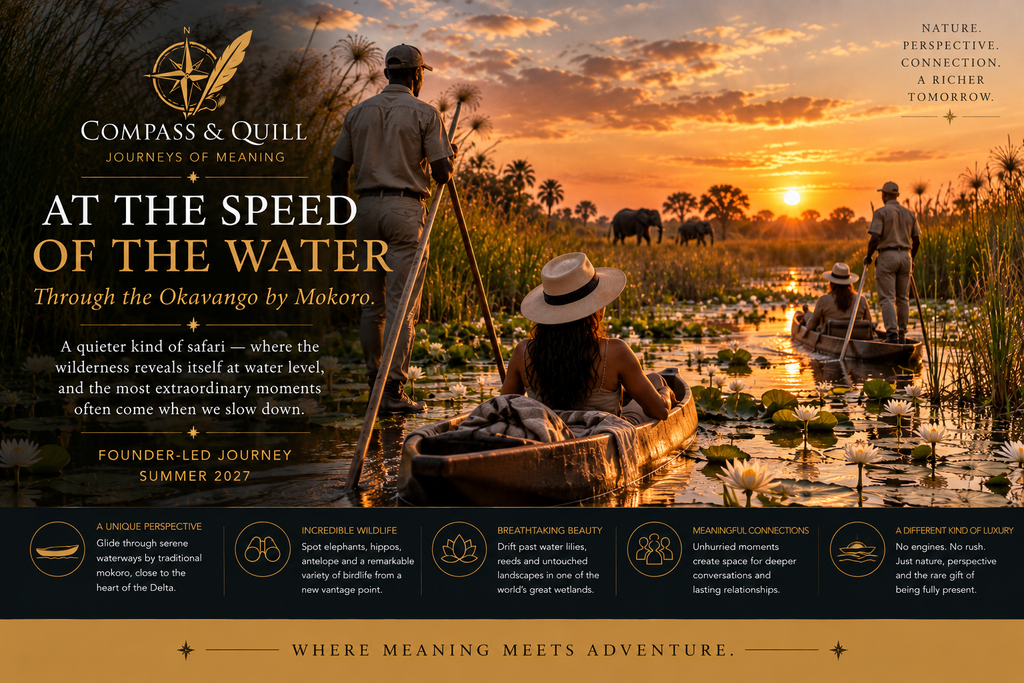
At the Speed of the Water: Through the Okavango by Mokoro
“There are places that cannot be rushed. The only way to truly experience them is to move at their pace.”
The first thing you notice is what you don’t hear.
No engine.
No tires moving across gravel.
No rush of wind.
Instead, there is water.
The call of a bird somewhere beyond the reeds.
The occasional movement of something you cannot quite see.
And the gentle sound of a pole entering the water as your mokoro glides forward.
This is the Okavango Delta.
But this time, we’re not observing it from the height of a safari vehicle.
We’re moving through it almost at eye level with the water.
Slowly.
Quietly.
And entirely on its terms.
During our 2027 Compass & Quill Founder-Led Journey through Southern Africa, this may become one of the least dramatic experiences on the itinerary.
It may also become one of the most memorable.
First, What Exactly Is a Mokoro?
A mokoro is a traditional dugout-style canoe associated with Botswana’s Okavango Delta.
Historically carved from tree trunks, many used in tourism today are made from more sustainable materials designed to preserve the traditional form without requiring mature trees to be felled.
Unlike a conventional boat powered by an engine, the mokoro is propelled by a skilled poler, who stands at the back and uses a long pole to guide the vessel through the Delta’s shallow channels.
The result is an experience unlike almost any other form of safari.
You don’t move quickly.
You aren’t supposed to.
Welcome to a Different Kind of Safari
Most safari imagery is defined by distance.
A vehicle stops.
Binoculars rise.
Cameras zoom.
Wildlife is observed across the landscape.
A mokoro changes that relationship.
You are low.
Close to the water.
Reeds rise beside you.
Water lilies appear almost within reach.
Tiny frogs, insects, birds, and plants that might disappear into the background from a vehicle suddenly become part of the experience.
The scale changes.
And when the scale changes, so does your attention.
You begin noticing smaller things.
That may be one of the Delta’s greatest gifts.
A River That Never Reaches the Sea
The Okavango is unusual.
Instead of flowing toward an ocean, the river travels inland and spreads across the sands of the Kalahari, creating an enormous wetland system in northern Botswana.
Water arrives and transforms the landscape.
Channels fill.
Floodplains expand.
Wildlife gathers.
Vegetation responds.
Then the water gradually recedes.
The Delta breathes with the seasons.
From above, its scale is extraordinary.
From a mokoro, however, you experience something much more intimate.
Not an ecosystem as a concept.
An ecosystem happening around you.
The Guide Sees What You Don’t
One of the most humbling parts of traveling through wilderness is realizing how little most of us actually notice.
A guide may stop because of a sound you didn’t hear.
Point toward movement you never saw.
Identify tracks that looked like marks in the mud.
Recognize a bird from its call.
Notice a change in the water.
Read the landscape almost like a language.
Expertise changes what is visible.
Without it, we may look directly at something and never understand what we’re seeing.
There is a lesson in that far beyond safari.
Sometimes the difference between looking and understanding is simply knowing what deserves attention.
At the Speed of the Water
There will be moments on our Founder-Led Journey when we move quickly.
Aircraft will carry us between countries.
A helicopter will rise above Victoria Falls.
Safari vehicles will take us across wilderness.
Cities will introduce new energy.
But the mokoro asks us to move differently.
At the speed of the water.
There is no overtaking.
No rushing ahead.
No attempt to squeeze one more experience into the hour.
The landscape determines the pace.
For people accustomed to controlling schedules, that surrender can feel unfamiliar.
Perhaps that is exactly why we need it.
Founders Are Trained to Accelerate
Entrepreneurship celebrates speed.
Move faster.
Launch sooner.
Respond immediately.
Scale.
Optimize.
Accelerate.
Sometimes speed is necessary.
But speed also has a cost.
When everything moves quickly, our field of vision narrows.
We notice what is urgent.
We miss what is subtle.
The person whose tone changed during a meeting.
The idea that isn’t fully formed yet.
The opportunity hidden inside an unexpected conversation.
The warning sign that wasn’t dramatic enough to demand immediate attention.
A mokoro isn’t going to teach anyone how to run a company.
But it may remind us of something leadership occasionally forgets:
Not everything important announces itself loudly.
What Happens When We Become Quiet
The quieter we become, the more the Delta seems to reveal.
Bird calls become distinct.
Ripples attract attention.
Movement among the reeds suddenly matters.
The landscape that initially appeared peaceful begins to feel incredibly alive.
Nothing changed.
We did.
Our attention sharpened.
This is one of the reasons I believe meaningful travel can be so restorative.
It changes what we pay attention to.
And attention may be one of the most valuable resources we possess.
The Luxury of Going Slowly
Luxury travel is frequently associated with speed and convenience.
Private transfers.
Priority access.
Shorter waits.
Effortless connections.
All of those things can make a journey more comfortable.
But there is another kind of luxury.
Having enough time that you don’t need to hurry.
The mokoro represents that beautifully.
We aren’t racing toward an attraction.
We aren’t trying to cover maximum distance.
The experience itself is the movement.
There is nowhere else we need to get to.
And suddenly, slow doesn’t feel inefficient.
It feels privileged.
Respecting the Wilderness
An experience like this also reminds us that we are visitors.
The Delta does not exist for our entertainment.
It is a living ecosystem supporting wildlife and communities whose relationship with this landscape extends far beyond our brief time there.
Responsible wilderness travel requires humility.
We observe.
We listen to our guides.
We respect distance.
We follow local expertise.
And we leave knowing that the privilege was not simply seeing the Delta.
It was being allowed to enter it.
That distinction matters.
The Moments Nobody Can Schedule
Perhaps we’ll see elephants in the distance.
Perhaps an antelope will appear near the water.
Perhaps something extraordinary will happen that becomes the story everyone tells over dinner.
Or perhaps nothing dramatic happens at all.
We simply glide through reeds beneath an enormous Botswana sky.
And that is enough.
One of the things I love most about wilderness travel is that it refuses to perform on command.
The itinerary can place us there.
The guides can position us beautifully.
But nature decides the rest.
There is freedom in accepting that.
Why This Experience Belongs on Our Journey
The Founder-Led Journey isn’t designed to keep our travelers constantly stimulated.
It is designed to create contrast.
The thunder of Victoria Falls.
The vastness of Namibia.
The energy of Johannesburg.
The elegance of Cape Town.
The wildlife of Chobe.
And here, in the Okavango Delta:
Quiet.
Every chapter contributes something different.
The mokoro doesn’t need spectacle.
Its power is intimacy.
It brings us close enough to notice.
What Will We Hear?
I suspect that when we return home, some memories will arrive visually.
A herd of elephants.
The orange dunes of Namibia.
Table Mountain.
Victoria Falls.
But perhaps this one will return as sound.
Water moving beneath the mokoro.
A pole slipping quietly into the channel.
Birds calling from somewhere among the reeds.
And then silence.
The kind of silence that isn’t empty at all.
It is full of things we finally slowed down enough to hear.
Looking Ahead to 2027
Next June, sixteen travelers will make their way into one of the world’s most remarkable inland wetlands.
We’ll leave the engines behind.
We’ll sit low against the water.
We’ll follow narrow channels through the reeds.
We’ll trust the people who understand this landscape far better than we do.
And for a little while, we will move at a pace the modern world rarely permits.
No acceleration.
No optimization.
No race toward what comes next.
Just water.
Wilderness.
Attention.
And the extraordinary discovery that sometimes slowing down doesn’t mean experiencing less.
It allows us to experience more.
Where Meaning Meets Adventure.
Leave a Reply