“Some places show us how beautiful the world is. Others remind us just how briefly we are passing through it.”
There are landscapes that look familiar even when you have never visited them.
And then there is Sossusvlei.
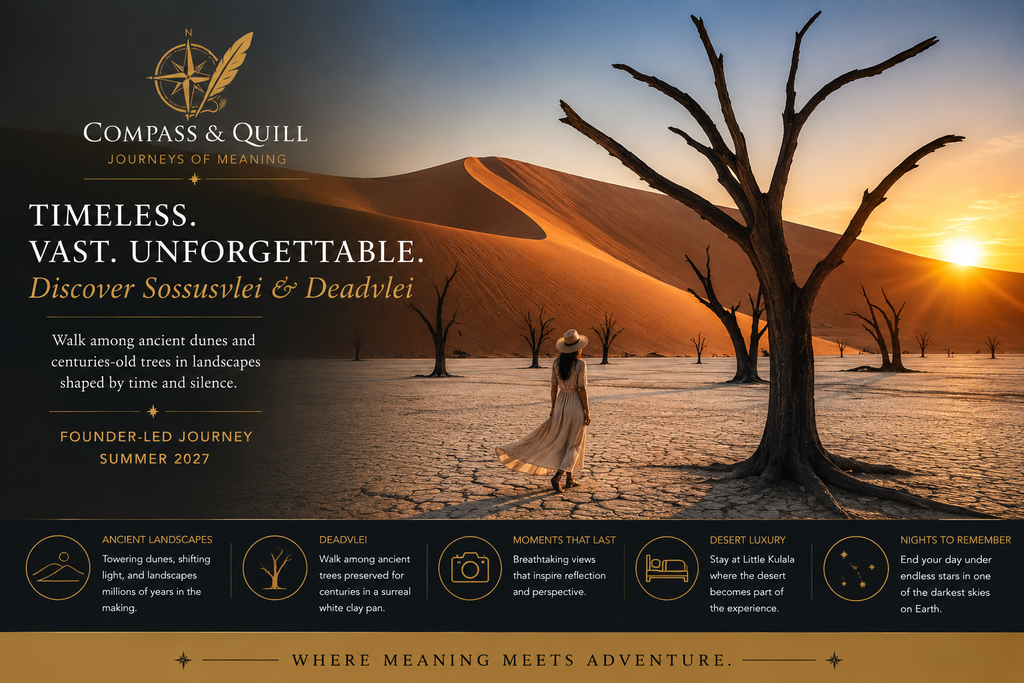
Imagine towering dunes rising from the desert floor in shades of burnt orange and crimson.
An impossibly blue African sky.
Brilliant white clay pans stretching beneath your feet.
And, standing against it all, the dark silhouettes of ancient trees that stopped growing centuries ago but remain preserved by one of the driest environments on Earth.
It almost doesn’t look real.
Yet this remarkable corner of Namibia is very real—and next year, it becomes another chapter in our Compass & Quill Founder-Led Journey through Southern Africa.
We have already shared what it will be like to float above the Namib Desert at sunrise.
This time, we’re coming back down to earth.
Because some landscapes deserve to be walked.
Welcome to Sossusvlei
Deep within Namibia’s Namib-Naukluft region lies Sossusvlei, one of Africa’s most recognizable desert landscapes.
Here, enormous sand dunes surround pale clay pans formed over thousands of years as the desert gradually changed the course of the Tsauchab River.
The scale is difficult to appreciate in photographs.
Some of the dunes rise hundreds of meters above the desert floor.
Their ridgelines shift with the wind.
Their colors change throughout the day.
At sunrise, one side may glow brilliant orange while the other remains almost completely in shadow.
By midday, the entire landscape has transformed.
The desert is never truly still.
Even when it appears to be.
Then You Reach Deadvlei
Not far from Sossusvlei is a place that feels almost otherworldly.
Deadvlei.
Centuries ago, water from the Tsauchab River reached this clay pan, allowing camel thorn trees to grow.
Then the climate changed.
The dunes shifted.
Water stopped reaching the area.
The trees died.
But the extreme dryness prevented them from decomposing.
And so they remain.
Blackened trunks standing against white earth.
Surrounded by enormous red dunes.
Beneath a brilliant blue sky.
Some of these trees are believed to have been standing here, preserved by the desert, for hundreds of years.
There is something almost haunting about them.
But there is also something extraordinarily beautiful.
A Landscape That Changes Your Sense of Time
Modern life teaches us to measure almost everything in minutes.
Meetings.
Deadlines.
Flights.
Appointments.
Productivity.
We organize our lives around calendars and clocks.
Then you stand somewhere like Deadvlei.
The dunes around you have been forming for thousands upon thousands of years.
The desert itself is tens of millions of years old.
Trees that died centuries ago still stand before you.
Suddenly, the urgency of Tuesday afternoon feels remarkably small.
That is one of travel’s greatest gifts.
It changes scale.
Not only geographically.
Emotionally.
It reminds us that the world existed long before our problems arrived—and will continue long after they have passed.
The Climb
For those who choose to experience Namibia’s dunes on foot, there is another lesson waiting.
Climbing a sand dune looks deceptively simple.
It isn’t.
Every step sinks.
The ridge continues farther than expected.
Progress becomes slow and deliberate.
You stop trying to rush.
Eventually, you find your rhythm.
Step.
Breathe.
Step.
Breathe.
And then you reach the top.
Below you, the desert unfolds in every direction.
The reward isn’t simply the view.
It’s knowing you earned the perspective.
Perhaps there is something familiar about that for founders.
The most worthwhile things rarely happen quickly.
Why This Experience Belongs on a Founder-Led Journey
There is a reason we call this a Founder-Led Journey rather than simply a luxury vacation.
Yes, we want extraordinary accommodations.
Exceptional service.
Remarkable food.
And experiences most travelers will remember for the rest of their lives.
But we also want moments that create space for thought.
Founders spend much of their lives building.
Solving.
Deciding.
Leading.
Responding.
Planning what comes next.
Places like Sossusvlei interrupt that rhythm.
The desert doesn’t need anything from you.
There is no decision to make.
No problem to solve.
No performance required.
For a few hours, your only responsibility is to look around.
That may sound simple.
For many of us, it has become surprisingly rare.
Our Home in the Desert
Our Namibia experience includes time at Little Kulala, where the desert itself becomes part of the stay.
This is precisely the kind of property we seek for Compass & Quill journeys.
Not luxury separated from the destination.
Luxury integrated into it.
The landscape remains the protagonist.
You wake surrounded by desert.
You watch the light change across the dunes.
And when darkness arrives, the sky becomes part of the experience.
There is something profoundly different about staying somewhere that doesn’t simply give you access to a destination.
It allows you to inhabit it.
When Darkness Becomes Part of the Experience
Namibia’s desert is extraordinary during the day.
At night, it becomes something else entirely.
Away from the light pollution of major cities, the sky opens.
Stars appear in numbers most of us rarely see anymore.
The Milky Way stretches overhead.
The silence deepens.
And suddenly the same desert that seemed enormous during daylight feels small beneath an even larger universe.
For guests accustomed to cities, airports, screens, and constant artificial light, the experience can be startling.
There is nowhere to scroll.
Nothing competing for attention.
Only darkness.
Stars.
And perspective.
What the Desert Teaches Us About Legacy
Perhaps this is what fascinates me most about Deadvlei.
Those trees haven’t produced leaves in centuries.
Yet they remain part of the landscape.
They have outlived generations.
They have become something entirely different from what they once were, yet their presence still matters.
There is an interesting question hidden there.
What remains after our season of building is over?
For founders, leaders, and anyone intentionally creating something larger than themselves, that is worth considering.
We spend enormous amounts of energy thinking about growth.
Perhaps we should occasionally think about permanence too.
Not simply:
What am I building?
But:
What will remain because I built it?
Travel has an interesting way of asking questions we didn’t know we needed to consider.
The Compass & Quill Philosophy
Our journey through Southern Africa is deliberately filled with contrast.
There will be moments of exhilaration.
A helicopter above Victoria Falls.
Wildlife encounters along the Chobe River.
A balloon rising over the Namib at sunrise.
There will be moments of indulgence.
Beautiful accommodations.
Exceptional meals.
Long afternoons around a table.
And then there will be places like Sossusvlei.
Places that ask us to become quiet.
To observe.
To think.
To remember how vast the world really is.
Because meaningful travel isn’t simply about collecting extraordinary experiences.
Sometimes it is about allowing extraordinary places to reveal something to us.
Looking Ahead to 2027
Next June, we’ll walk across landscapes shaped over millions of years.
We’ll stand beneath some of the world’s tallest dunes.
We’ll see ancient trees preserved against a white desert floor.
We’ll watch sunlight transform the Namib from gold to crimson.
And perhaps, somewhere in all that vastness, we’ll think differently about time.
About what we’re building.
About what matters.
About what we want to leave behind.
There will be plenty of photographs.
But I suspect the most valuable thing we carry away from Sossusvlei won’t fit inside a camera.
It will be perspective.
And that may be one of the greatest souvenirs travel can give us.
Where Meaning Meets Adventure.
Leave a Reply