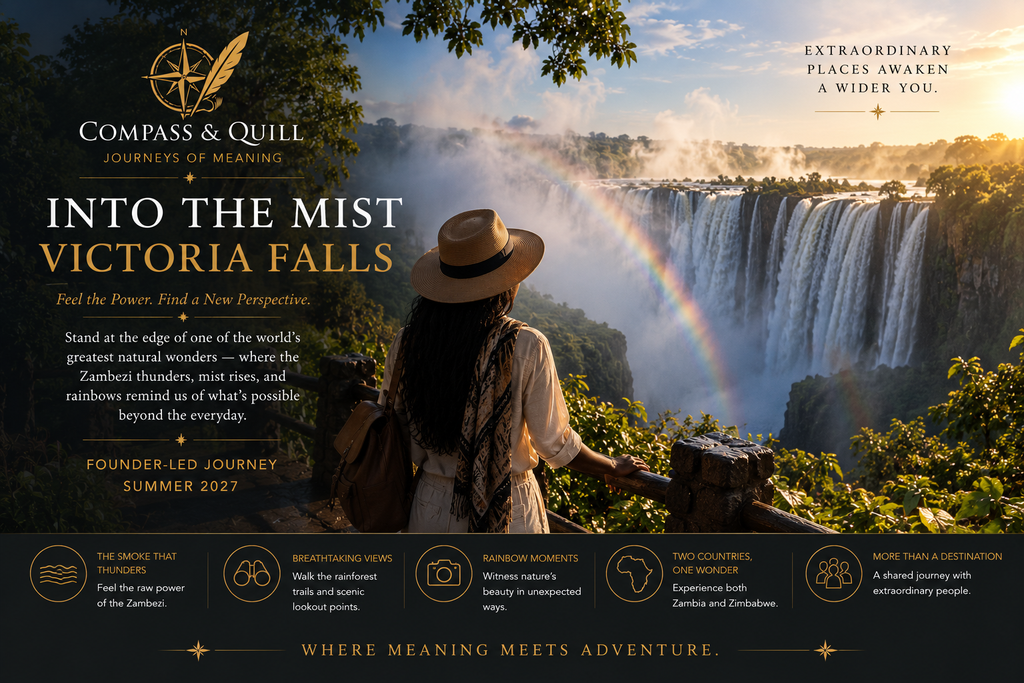
Into the Mist: Standing at the Edge of Victoria Falls
“Some places are meant to be seen. Others demand to be felt.”
Long before you see Victoria Falls, you may hear it.
A distant roar rises above the landscape.
Then comes the mist.
It hangs in the air, drifts above the trees, catches the sunlight, and announces that somewhere just ahead, the Zambezi River is doing something extraordinary.
Then you reach the edge.
Suddenly, the photographs you’ve seen no longer seem adequate.
An immense curtain of water disappears into a gorge below. Mist rises back toward the sky. Rainbows form and vanish. The sound surrounds you.
This is Mosi-oa-Tunya.
The Smoke That Thunders.
And during our 2027 Compass & Quill Founder-Led Journey through Southern Africa, we won’t simply fly above this extraordinary landscape.
We’ll step into it.
Where a River Disappears
For much of its journey toward Victoria Falls, the Zambezi appears deceptively calm.
Broad stretches of water move through the landscape, dotted with islands and surrounded by vegetation.
Then the geology changes everything.
The river reaches a vast fracture in the basalt plateau and plunges dramatically into the narrow gorge below.
From the walking paths, you don’t experience this as a distant panorama.
You are remarkably close to it.
You hear the force of the water.
You feel moisture against your skin.
Depending on seasonal conditions, the mist can become so intense that walking near the Falls feels like stepping into a sudden tropical rainstorm.
Nature stops being scenery.
It becomes immersive.
Why We Need Both Perspectives
Earlier, we shared another extraordinary experience awaiting our travelers: seeing Victoria Falls from a helicopter.
From above, you understand its scale.
You see the Zambezi approaching the precipice.
You see the gorges carved into the landscape.
You understand how the Falls fit within a much larger geological story.
But standing beside them offers something the sky cannot.
You feel their power.
The two perspectives complement one another beautifully.
One provides distance.
The other provides intimacy.
And perhaps there is a lesson there.
Sometimes we need to rise above something to understand it.
Other times, we need to stand close enough to feel it.
The Smoke That Thunders
The indigenous name for Victoria Falls may be one of the most evocative descriptions of a natural wonder anywhere in the world.
Mosi-oa-Tunya.
The Smoke That Thunders.
It describes precisely what happens here.
From a distance, the immense spray resembles smoke rising above the landscape.
Up close, the roar of falling water becomes almost physical.
The name reminds us of something important about travel:
Places already have stories before we arrive.
Names.
Meanings.
Histories.
Ways of understanding the landscape that existed long before it appeared on an international travel itinerary.
Meaningful travel asks us to encounter those stories—not simply the attraction.
The Rainbows
Then there are the rainbows.
Sunlight passing through the mist can produce brilliant arcs of color across the gorge.
Sometimes one appears.
Sometimes several.
Sometimes they emerge for only a moment before disappearing again.
You cannot schedule them.
You cannot ask nature to hold the light while everyone gets the perfect photograph.
You simply have to be paying attention.
That unpredictability is one of the things I love about experiences like this.
The itinerary can bring us to the right place.
But the moment itself still belongs to nature.
When Awe Makes Us Quiet
Founders spend a remarkable amount of time being responsible for answers.
What should we do next?
How do we solve this?
What happens if the plan changes?
Where should we invest?
Who needs a decision?
Leadership requires constant mental activity.
Awe interrupts it.
Stand before something powerful enough, ancient enough, or beautiful enough, and for a few moments there is nothing to solve.
You simply look.
That experience has value.
Researchers have increasingly explored the relationship between awe and our perception of ourselves within something larger.
Travel has always understood this intuitively.
Sometimes we need encounters that remind us the world is much bigger than the problems occupying our calendars.
Victoria Falls does that exceptionally well.
A Journey Through Two Countries
Victoria Falls also occupies a fascinating geographic position along the border between Zambia and Zimbabwe.
And our Founder-Led Journey intentionally includes both countries.
That matters because borders may divide maps, but landscapes rarely behave so neatly.
The Zambezi connects ecosystems, communities, histories, and economies across Southern Africa.
Experiencing this region encourages us to think beyond individual destinations.
We begin to see Southern Africa not as a collection of isolated stops, but as an interconnected story.
Waterways cross boundaries.
Wildlife crosses boundaries.
Cultures influence one another.
History crosses boundaries.
And travelers do too.
Why This Belongs on the Founder-Led Journey
Our journey was never designed around simply collecting famous places.
Victoria Falls certainly deserves its place on any list of the world’s great natural wonders.
But that isn’t why it belongs here.
It belongs because of what it contributes to the rhythm of the journey.
Awe.
Before Botswana asks us to become still…
Before Namibia gives us space to reflect…
Before Cape Town invites us to celebrate…
Victoria Falls reminds us what it feels like to be completely astonished.
There is value in beginning a journey that way.
The Luxury of Being Fully Present
Luxury travel is often discussed in terms of accommodations, transportation, dining, and service.
Those things matter.
We have intentionally chosen exceptional properties and experiences throughout this journey.
But there is another form of luxury that cannot be purchased quite so easily.
Undivided attention.
Standing beside Victoria Falls while thinking about emails would almost feel absurd.
The landscape demands your presence.
The sound.
The mist.
The movement.
The scale.
Everything conspires to pull you into the moment.
And perhaps that is one of the reasons we travel so far from home.
Sometimes distance helps us become present again.
What Will You Remember?
Years after a journey like this, details inevitably fade.
You may forget what you ordered for dinner on a particular evening.
You may forget the exact departure time of a flight.
You may even forget the name of an excursion.
But you probably won’t forget the first time you stood beside Victoria Falls.
You’ll remember the roar.
The mist.
The rainbow that appeared unexpectedly.
The person standing beside you.
The feeling of realizing that something you had seen countless times in photographs was suddenly right there.
Real.
Immense.
Alive.
Those are the moments that become part of our personal history.
Looking Ahead to 2027
Next June, our travelers will experience Victoria Falls from more than one perspective.
We’ll see its extraordinary scale from the sky.
Then we’ll come back to earth and stand close enough to feel its power.
Afterward, the journey continues.
Botswana.
Namibia.
Cape Town.
Safari, desert, culture, food, conversation, reflection, and extraordinary hospitality.
But before all of that, there will be this moment.
Standing beside the Zambezi.
Mist in the air.
Thunder rising from the gorge.
And sixteen travelers realizing that the journey they’ve imagined for months has truly begun.
Some destinations welcome you quietly.
Victoria Falls makes an entrance.
And we wouldn’t want to begin this adventure any other way.
Where Meaning Meets Adventure.
Leave a Reply